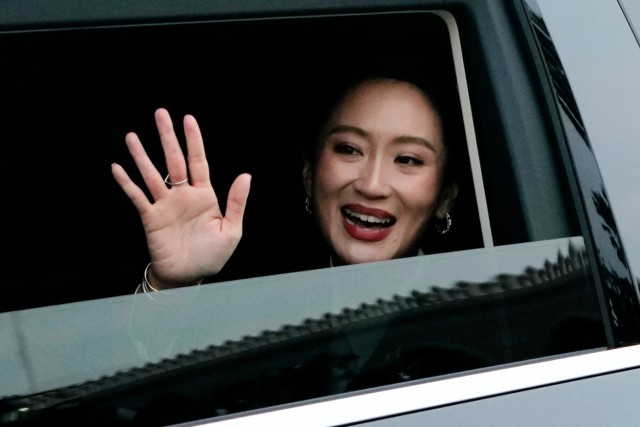
Thailand’s suspended Prime Minister Paetongtarn Shinawatra waves as she leaves the Government House after being dismissed from her position, in Bangkok, Thailand, Friday, Aug. 29, 2025.
Thailand has plunged into political turmoil once again. The country’s Constitutional Court dismissed Prime Minister Paetongtarn Shinawatra on Friday. Judges ruled that she breached ethical standards during a controversial phone call with Cambodia’s former leader Hun Sen.
The verdict ends the short-lived tenure of Thailand’s youngest prime minister. It also marks another setback for the Shinawatra family, which has dominated Thai politics for decades but often clashed with the courts and military.
Court Rules Against Paetongtarn
The ruling was delivered in a 6-3 decision. Judges concluded that Paetongtarn’s June 15 phone call compromised Thailand’s national interests.
During the call, she addressed Hun Sen as “uncle” and referred to a senior Thai army general as an “opponent.” The conversation was leaked weeks before deadly border clashes between Thailand and Cambodia erupted.
A group of senators filed the complaint, alleging Paetongtarn’s actions aligned with Cambodia’s interests. They claimed her remarks lacked honesty and violated ethical standards expected of the office.
While the court acknowledged her intent to protect Thai sovereignty, the majority still viewed her tone and comments as a breach of ethics.
Paetongtarn Defends Herself
Paetongtarn, 39, rejected allegations of wrongdoing. She argued that her informal tone was a negotiation tactic to calm tensions.
She admitted the call may have sounded overly friendly but stressed that her goal was to save lives and prevent escalation.
“I accept the court’s ruling,” she said after the verdict. “But I am innocent. My actions were only to protect the nation and its people.”
Despite her defense, the court’s decision has forced her out of office.
The Leaked Call That Sparked Crisis
The phone call was made public by Hun Sen, who ruled Cambodia for 38 years before handing power to his son Hun Manet in 2023.
Tensions between Thailand and Cambodia were already rising after a Cambodian soldier was killed in a border skirmish in May.
By late June, both countries engaged in five days of intense clashes. The conflict left dozens dead and forced more than 260,000 civilians to flee their homes.
For many Thais, the warm tone of Paetongtarn’s call revived suspicions about her family’s ties with Hun Sen.
The Shinawatra Dynasty Under Fire Again
Paetongtarn belongs to the powerful Shinawatra clan. Her father, Thaksin Shinawatra, was prime minister from 2001 to 2006 before being ousted by a coup.
Thaksin’s sister, Yingluck Shinawatra, also served as prime minister from 2011 to 2014 before facing removal by court order. Even Thaksin’s brother-in-law briefly held the role in 2008.
Each Shinawatra leader rose through strong electoral victories, only to be forced out prematurely by the military or judiciary.
The dynasty remains popular among working-class voters but is deeply distrusted by Thailand’s conservative elite, military, and monarchy defenders. Critics accuse the family of corruption and undermining traditional institutions.
Political Fallout in Bangkok
Paetongtarn’s removal has thrown Thai politics into uncertainty. Her party, Pheu Thai, now leads a weakened coalition after its key ally, the Bhumjaithai Party, withdrew support over the phone call scandal.
She had already been suspended on July 1, when the court agreed to hear the case. Deputy Prime Minister Phumtham Wechayachai has been acting as caretaker leader since then.
The caretaker Cabinet remains in place until parliament elects a new prime minister. Lawmakers may also dissolve parliament and call fresh elections if no consensus is reached.
Thailand Faces Another Period of Instability
The ruling against Paetongtarn comes at a time of economic hardship. Thailand’s economy has struggled to recover from the COVID-19 pandemic, fueling discontent with the government.
Now, with the prime minister dismissed and her coalition fractured, the country faces renewed political instability.
For the Shinawatra dynasty, the ruling is another major blow. For Thailand, it signals more uncertainty in a nation long caught between populist leaders, powerful elites, and judicial intervention.