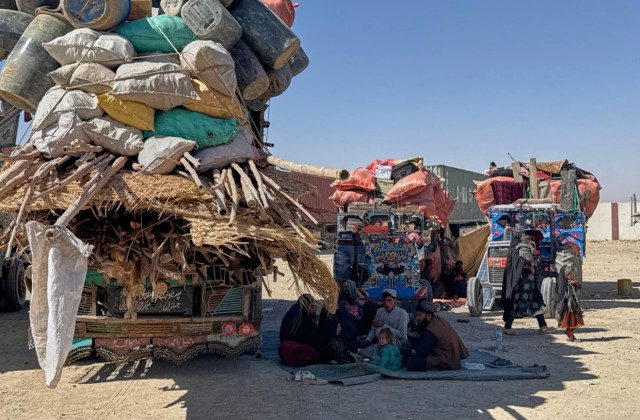
Afghan refugees sit next to their belongings loaded onto vehicles as they wait for the reopening of the border crossing point, which closed after Afghan and Pakistani security forces exchanged fire, at a camp in Chaman, Pakistan, Sunday, Oct. 12, 2025
Tensions between Pakistan and Afghanistan escalated sharply over the weekend, forcing the closure of major border crossings for a second consecutive day. The shutdown has halted trade and stranded hundreds on both sides, heightening fears of prolonged disruption.
The clashes erupted late Saturday when Afghan forces reportedly targeted several Pakistani military posts along the Durand Line. Afghan officials claimed they killed 58 Pakistani soldiers, accusing Islamabad of repeated violations of Afghan territory and airspace.
Pakistan, however, dismissed those figures, saying 23 of its soldiers were killed while over 200 “Taliban and affiliated terrorists” were neutralized in retaliatory fire.
Ceasefire Holds After Deadly Weekend
By Monday, the border remained tense but calm, with no new exchange of fire reported since Sunday. Both sides appeared to be observing a fragile ceasefire following international calls for restraint from countries like Saudi Arabia.
Pakistan’s Defense Minister Khawaja Mohammad Asif and Army Chief Field Marshal Asim Munir attended a mass funeral in Rawalpindi for the slain soldiers. A military statement reaffirmed Pakistan’s determination to “thwart any aggression and conspiracy against the nation with full support of the people.”
Trade and Movement at a Standstill
Officials confirmed that all major Pakistan-Afghanistan border crossings were closed to trade and passenger movement as of Monday. The 2,611-kilometer frontier, known as the Durand Line, has long been a source of contention between the two neighbors.
In Afghanistan, border police spokesperson Abidullah Uqab said crossings would remain shut until further notice. The exact date for reopening remains uncertain.
At the southwestern Chaman crossing, authorities briefly permitted about 1,500 Afghan nationals stranded since Sunday to walk home, according to government officer Imtiaz Ali. However, commercial activity remains suspended.
Key Crossings Like Torkham Remain Closed
The northwestern Torkham crossing, a vital trade route between the two countries, stayed completely closed on Monday. Local traders, represented by Mujib Ullah, confirmed that all travel and transport operations were suspended.
Hundreds of Afghan refugees, many affected by Pakistan’s ongoing crackdown on undocumented foreigners, were left waiting. Some, like refugee Gul Rahman, returned to Peshawar after being stranded at Torkham.
“Hundreds of others like me have moved to nearby areas or returned to Peshawar,” Rahman said. “We’ll wait here until the border reopens.”
Longstanding Disputes Fuel Rising Hostility
The weekend clashes follow a week of heightened tension after Afghanistan’s Taliban government accused Pakistan of carrying out deadly airstrikes in Kabul and a market in eastern Afghanistan. Pakistan did not claim responsibility, but the incident deepened mistrust between the two sides.
Islamabad has previously conducted strikes inside Afghanistan, claiming to target militant hideouts of Tehreek-i-Taliban Pakistan (TTP), a banned group it blames for attacks inside Pakistan. Kabul, however, denies sheltering militants, insisting it does not allow its soil to be used against any country.
Border Crisis Adds to Regional Strain
The closure of the Pakistan-Afghanistan border underscores the fragile nature of their relations, rooted in decades of political, security, and territorial disputes. As hundreds remain stranded and trade grinds to a halt, both nations face mounting pressure to de-escalate and restore normalcy along one of South Asia’s most volatile borders.
Until then, uncertainty looms large — with the border’s reopening hinging on whether both sides can maintain peace after one of their deadliest confrontations in recent years.