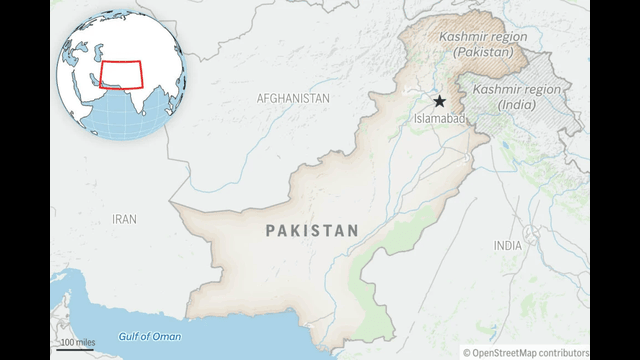
This is a locator map for Pakistan with its capital, Islamabad, and the Kashmir region.
Pakistani security forces launched a series of intelligence-based operations in the country’s volatile northwest, killing 38 militants linked to the Pakistani Taliban. The raids, conducted across multiple districts near the Afghan border, marked one of the most extensive counterterror actions in recent months.
Coordinated Raids Target Militant Hideouts
Troops began their operations on Sunday in Dera Ismail Khan, a troubled district in Khyber Pakhtunkhwa province. The military reported that 10 militants linked to the Tehrik-e-Taliban Pakistan (TTP) were killed during the first raid.
A second operation on the same day unfolded in North Waziristan, where forces killed five additional militants, including a senior militant commander. Authorities described the target as a high-value individual involved in planning attacks on security personnel.
Twin Operations Eliminate 23 Militants
The counterterror campaign continued on Monday with two more raids in Bajaur and Bannu districts. These operations resulted in the deaths of 23 militants, the military said in a statement on Tuesday.
The security forces emphasized that all neutralized individuals were part of coordinated militant networks responsible for attacks in the northwest. The raids were launched after intelligence agencies tracked their movements near the border region.
Militants Identified as “Khawarij”
In its statement, the military referred to the militants as “Khawarij,” a term often used by Pakistani authorities for insurgents they claim receive backing from Afghanistan and India.
The label is commonly applied to factions associated with the banned Tehrik-e-Taliban Pakistan. Kabul and New Delhi strongly deny any links to the group or involvement in cross-border militancy.
Pakistani Taliban Influence Growing Since 2021
The Pakistani Taliban (TTP) operates as a separate entity from the Afghan Taliban but maintains ideological and operational alignment.
Their influence has grown since the Afghan Taliban’s rise to power in 2021, a development that has renewed concerns in Islamabad. Pakistan believes many TTP leaders and fighters use Afghan territory as a safe haven, enabling them to regroup, plan attacks, and slip across the border.
This cross-border presence continues to strain relations between Pakistan and Afghanistan, with Islamabad urging Kabul to act against TTP sanctuaries.
Escalating Tensions Along the Border
The northwestern region bordering Afghanistan has long served as a hub for militant networks. Recent months have seen a spike in attacks targeting security checkpoints and convoys.
Pakistan has responded by ramping up intelligence-led counterterror operations, particularly in Khyber Pakhtunkhwa. The latest raids reflect a broader strategy to dismantle militant infrastructure before winter sets in and mobility becomes more difficult.
Military Says Operations Will Continue
Authorities stated that the successful raids were part of an ongoing nationwide effort to eliminate militant threats. Troops recovered weapons, ammunition, and communication devices from the hideouts.
Military officials emphasized that more operations will follow, with a clear focus on preventing militants from regrouping in border areas. They added that the recent killings dealt a significant blow to TTP networks attempting to reestablish footholds in the region.
A Persistent Security Challenge
Despite major offensives in previous years, militancy remains a persistent challenge for Pakistan’s security apparatus. The rugged border terrain, porous crossings, and political shifts in Afghanistan have complicated counterterror operations.
With 38 militants killed in coordinated actions across four districts, Pakistan’s military says it remains committed to restoring stability in Khyber Pakhtunkhwa. But the evolving threat posed by the TTP continues to underscore the need for sustained intelligence cooperation and deeper regional security coordination.