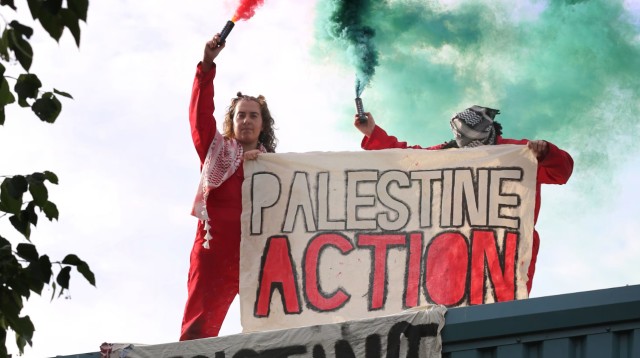
Activists hold a banner saying "Palestine Action" while letting off smoke flares in Brandon, United Kingdom, on Tuesday.
UK lawmakers have voted to ban Palestine Action, sparking widespread condemnation from human rights groups, UN experts, and political figures. The controversial move, passed on Wednesday in the House of Commons, puts the activist group on par with globally recognized terror organizations under UK law.
Crackdown on Pro-Palestinian Protest Group
The vote passed overwhelmingly—382 in favour, 26 against. It came after two activists from Palestine Action infiltrated the UK’s largest air base and damaged two military aircraft by spraying red paint into their engines. The group said the aircraft were used to support military operations in Gaza and other regions, alleging UK complicity in war efforts.
The government’s action follows Home Secretary Yvette Cooper’s announcement on June 23 to proscribe the group under the UK’s anti-terror laws. The draft order now moves to the House of Lords for final approval. If passed, it will make membership, support, or even symbolic association with Palestine Action a criminal offense.
What the Ban Means for Protesters
Once the proscription becomes law, it will become illegal to be part of or support Palestine Action in any form. Violators could face up to 14 years in prison. Even wearing clothing or carrying symbols that suggest support could land individuals in jail for six months or incur hefty fines.
This move would mark the first time in British history that a direct-action protest group has been banned under anti-terror legislation. Legal experts and civil liberties advocates warn that this sets a dangerous precedent.
Palestine Action Strikes Back with Legal Challenge
Palestine Action announced on Monday it had launched legal proceedings to contest the ban. Co-founder Huda Ammori said the government's response resembles tactics used by authoritarian regimes worldwide.
“This is a clear attempt to criminalize dissent and silence those exposing the UK’s role in global conflict,” she said.
In its statement, the group criticized the government’s priorities. “The real crime is not the red paint,” it declared, “but the war crimes enabled by these aircraft through UK complicity in Israel’s genocide.”
Human Rights Groups Slam the Decision
Human rights organizations, including Amnesty International, have condemned the move. They argue that the decision violates fundamental freedoms of speech and peaceful assembly.
Sacha Deshmukh, CEO of Amnesty International UK, labelled the measure a "grave misuse of anti-terrorism powers." She warned MPs in a formal letter that this decision could pave the way for further repression of protest rights in the UK.
“By the weekend, millions in the UK could see their rights to free speech dramatically reduced,” she said.
UN Experts Voice Concern Over Freedom of Protest
United Nations experts have echoed concerns, warning against the “unjustified labelling” of Palestine Action as a terrorist entity. They stressed that political protest—even when provocative—should not be equated with terrorism.
Meanwhile, several UK politicians have spoken out in defence of the group. Labour MP Zarah Sultana expressed solidarity with the group on X, writing, “We are all Palestine Action.” Former Shadow Chancellor John McDonnell also criticized the move, stating, “This is not what anti-terror laws were made for.”
A Precedent That Could Change Protest Culture
The decision to criminalize Palestine Action marks a critical turning point in how the UK government handles civil disobedience. Critics fear that this could usher in a new era where protest groups risk being labelled as extremists, regardless of whether they pose a real threat to national security.