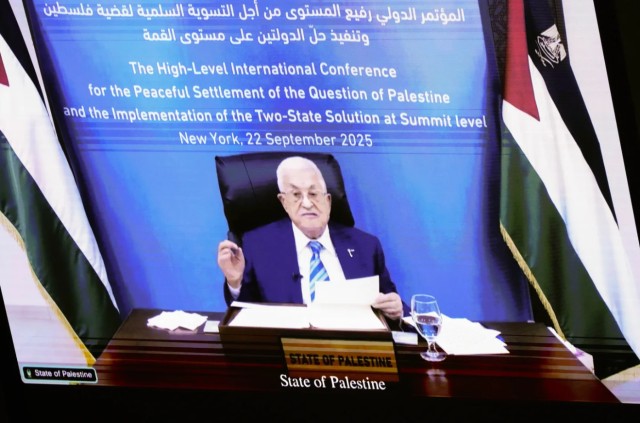
Palestinian President Mahmoud Abbas appears on a screen as he speaks virtually during a high-profile meeting at the United Nations aimed at galvanizing support for a two-state solution to the Israeli-Palestinian conflict Monday, Sept. 22, 2025, at UN headquarters.
France officially recognized Palestinian statehood on Monday at a major United Nations meeting. The move came as part of renewed international efforts to revive the two-state solution amid the ongoing Gaza war.
French President Emmanuel Macron made the announcement at the U.N. General Assembly, drawing applause from over 140 world leaders. The Palestinian delegation, led by U.N. ambassador Riyad Mansour, stood to celebrate the declaration.
Macron said France was staying true to its historic commitment to peace in the Middle East. “France recognizes the state of Palestine,” he told the assembly.
More Countries Join France in Recognition
Following France’s lead, several European nations, including Andorra, Belgium, Luxembourg, Malta, and Monaco, confirmed recognition of Palestine. A day earlier, the United Kingdom, Canada, Australia, and Portugal also announced similar moves.
However, Germany, Italy, and Japan stopped short of recognition, though they participated in the high-level U.N. conference.
Despite the wave of recognition, analysts say it may not immediately affect realities on the ground. Israel continues its Gaza offensive while also expanding settlements in the occupied West Bank.
U.N. Calls Palestinian Statehood a Right
U.N. Secretary-General Antonio Guterres reminded the world that Palestinian statehood is “a right, not a reward.” His statement was widely seen as a rebuke to Israel’s claim that recognition rewards Hamas for its October 7 attacks two years ago.
Mahmoud Abbas Calls for an End to Violence
Palestinian President Mahmoud Abbas addressed the meeting through video. The U.S. had revoked his visa. Abbas condemned all violence, including the 2023 Hamas attacks, and urged an end to civilian suffering.
He also announced reforms, including a new welfare system that no longer provides payments to families of militants killed or jailed by Israel. This was a key demand from both Israel and the United States.
Abbas also sent a message directly to Israelis: “Enough violence and war.” On the occasion of Rosh Hashanah, he extended new year wishes to Jews worldwide.
Global Push for a Two-State Solution
About three-fourths of the 193 U.N. members already recognize Palestine. Until recently, major Western powers resisted, insisting recognition could only come through negotiations with Israel.
Palestinians have welcomed the growing momentum. For many, it is seen as a step toward independence. “This is a glimmer of hope,” said Fawzi Nour al-Deen, one of thousands fleeing Gaza.
The two-state solution—creating a Palestinian state alongside Israel in the West Bank, Gaza, and East Jerusalem—remains the most widely supported path to peace.
Israel Strongly Opposes Recognition
Israeli Prime Minister Benjamin Netanyahu’s government has firmly rejected Palestinian statehood. Officials argue recognition only strengthens Hamas. Netanyahu has hinted at possible annexation of West Bank territories in response.
However, the United Arab Emirates, a signatory of the Abraham Accords, warned Israel against annexation, calling it a “red line.”
Netanyahu is expected to finalize Israel’s stance after meeting U.S. President Donald Trump in Washington next week. He will also address world leaders at the U.N. on Friday.
Trump Administration Backs Israel
The Trump administration has also opposed recognition. U.S. officials claim it undermines ceasefire talks with Hamas. Earlier this month, an Israeli strike targeted Hamas negotiators in Qatar, one of the main mediators.
Trump’s envoy, Steve Witkoff, abandoned negotiations in July, further stalling peace efforts.
A Divided Palestinian Leadership
France and Saudi Arabia have proposed a phased plan where a reformed Palestinian Authority, supported by international aid, governs both Gaza and the West Bank. The U.N. General Assembly overwhelmingly backed the plan with a 142-10 vote.
Hamas, which won elections in 2006, has hinted it might accept a state based on 1967 borders. Still, it officially demands full control over all land between the Mediterranean Sea and the Jordan River.
The deep political divide between Hamas in Gaza and the Palestinian Authority in the West Bank complicates the peace process.
Future of the Two-State Solution
Peace talks between Israelis and Palestinians have been stalled for over a decade. Settlement expansions and repeated violence have blocked progress.
Supporters of the two-state solution warn that without Palestinian statehood, Israel faces two bleak options. It can either continue ruling millions of Palestinians without equal rights, or risk becoming a binational state with no guaranteed Jewish majority.
The recognition of Palestinian statehood by France and other nations has renewed hope. Yet the road to lasting peace remains uncertain.