

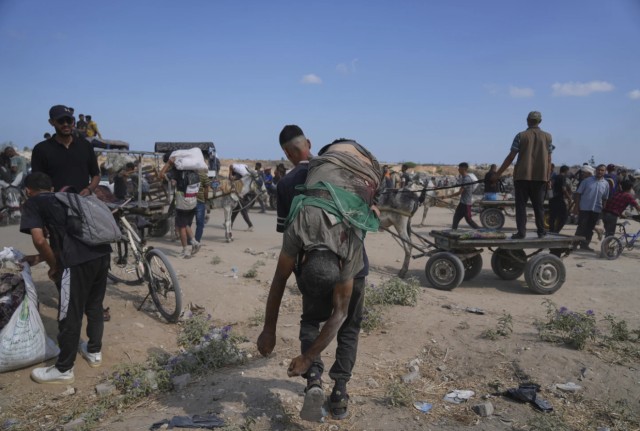
A Palestinian carries the body of a man killed while trying to receive aid near a distribution center operated by the U.S.-backed Gaza Humanitarian Foundation (GHF) in Netzarim, in the Gaza Strip, Monday, Aug. 4, 2025.
Dozens of Palestinians died or were injured Monday while rushing toward food aid across Gaza. Crowds scrambled for both airdropped packages and land-distributed supplies. Eyewitnesses and local health officials described scenes of chaos, stampedes, and Israeli gunfire.
Ongoing Israeli blockades and military operations have made safe aid delivery almost impossible. After nearly 22 months of war, the region inches closer to famine. International aid efforts have increased, but they remain critically insufficient.
Israel’s Restrictions Push Gaza Toward Famine
Despite recent Israeli measures allowing more aid, humanitarian groups say it's not enough. Hunger is now a daily reality. Families of hostages still held in Gaza also express fear for their loved ones’ survival — though they blame Hamas for their plight.
Since May, hundreds of Palestinians have reportedly died from Israeli gunfire while seeking aid. The UN and local health agencies confirm repeated attacks near distribution points. The Israeli military denies these figures, claiming only warning shots were fired.
Airdrops Offer Hope — But Often Bring More Danger
Several countries have resorted to airdropping food into Gaza. But aid groups warn these drops are expensive, risky, and largely ineffective. Many packages fall into the sea or into dangerous zones declared off-limits by the Israeli army.
In central Gaza's Zuweida, aid parcels floated down by parachute on Monday. AP footage captured hundreds of people racing toward them. Fights erupted. Men swung batons to seize whatever they could. In one tragic incident, a package landed on a tent, injuring a displaced man.
“This is inhuman,” said Rabah Rabah, waiting for the drop. “They should use the land crossings instead.”
Shootings Near Aid Routes Raise Alarm
Near the Zikim Crossing — a major entry point for northern Gaza — at least 16 people were killed Sunday night. Over 130 more were wounded, according to Shifa Hospital in Gaza City. Witnesses blame Israeli forces. The military has not commented.
In another deadly incident, 10 Palestinians were killed in the Morag Corridor. Israeli forces allegedly opened fire when young men tried to reach the front of the aid line. “They shot people in the head and back,” claimed survivor Mohammed al-Masri.
Nasser Hospital confirmed receiving bodies from both Morag and another southern aid site run by the Gaza Humanitarian Foundation (GHF). GHF denies any violence near its operations but admitted to occasionally using pepper spray and warning shots to prevent crowd crushes.
‘Every Day Feels Like a Death Trap’
In central Gaza, Al-Awda Hospital reported eight dead and over 50 wounded near another GHF site in the Netzarim Corridor. Witnesses again blamed Israeli gunfire. AP images showed men dragging injured people away, clutching bags of food amid the carnage.
“This is what we face every day,” said Ayman Ruqab, a young man who has tried for days to reach aid. “It’s a death trap.”
The Israeli army responded, saying it fired warning shots only when crowds posed a threat. It claimed no knowledge of casualties in those areas.
War Toll Mounts with No End in Sight
The war, sparked by Hamas-led attacks on October 7, 2023, has left Gaza devastated. That day, militants killed about 1,200 Israelis — mostly civilians — and took 251 hostages. Around 50 remain captive, with only 20 believed to be alive.
Since then, Israel’s offensive has killed more than 60,900 Palestinians, according to Gaza’s Health Ministry. Though the figures include both civilians and fighters, nearly half of the victims are women and children. The U.N. considers the ministry’s data credible. Israel disputes the numbers but offers no alternative.
A Crisis Without Resolution
As Gaza’s humanitarian crisis worsens, aid remains a lifeline — but one often laced with danger. Whether dropped from the skies or brought by convoys, food now comes with the risk of death.
And for those waiting in line, hope is dwindling — replaced by fear, hunger, and desperation.













