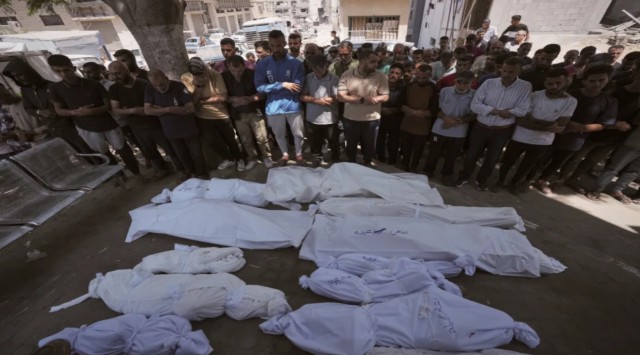
Mourners pray beside the bodies of Palestinians who were killed by an Israeli airstrike that struck a school used as a shelter, in Shifa Hospital in Gaza City, on Thursday, July 3, 2025.
Another devastating chapter unfolded in Gaza as Israeli strikes killed 94 Palestinians, many of whom were waiting for desperately needed humanitarian aid. The assault, which took place between Wednesday night and Thursday, has drawn renewed global concern over the humanitarian catastrophe unfolding in the war-torn region.
Families Shattered as Tent Camps and Streets Targeted
In southern Gaza, airstrikes hit a tent camp overnight, killing 13 members of a single family, including six children under the age of 12. Grief filled the air as families mourned their loved ones at morgues.
At Nasser Hospital in Khan Younis, Intisar Abu Assi wept over the bodies of her children and grandchildren, while another woman kissed a small girl wrapped in a blanket, lost to the violence.
In central Gaza, tragedy struck again. A strike near a falafel stand on Wednesday evening killed eight, including six-year-old Heba Abu Etiwi and her brother. A separate attack on a school sheltering displaced families in Gaza City took 15 more lives.
Aid Lines Turn Deadly
What should have been lines of hope turned into scenes of horror. According to hospital sources, 45 Palestinians were killed while trying to receive humanitarian aid.
Among them, five people were shot near food distribution routes operated by the Gaza Humanitarian Foundation (GHF) — a U.S.-backed organization endorsed by Israel. Another 40 were killed in various parts of Gaza while waiting for U.N. aid trucks.
Eyewitnesses claim Israeli troops often open fire on civilians near these zones. While the Israeli military insists it fires only warning shots, those on the ground tell a different story. Armed U.S. contractors guard the GHF sites, intensifying the tension in already volatile areas.
Amnesty: Starvation as a Weapon of War
Amnesty International issued a damning report on Thursday, accusing Israel of using starvation as a weapon. The report said the GHF system appears designed to appease global critics, while in reality, only limited food reaches Palestinians.
“Aid-seeking has become a booby trap for desperate, starved Palestinians,” Amnesty stated.
The group accused Israel of committing genocide by attacking civilians, destroying infrastructure, and blocking essential aid. Israel’s Foreign Ministry condemned the report, accusing Amnesty of spreading Hamas propaganda.
Controversial GHF Aid Program Sparks Global Criticism
Israel insists that GHF is a replacement for the U.N. aid system, which it claims is exploited by Hamas. But aid groups strongly reject this view, saying GHF cannot meet Gaza’s needs and puts Palestinians in more danger.
While Israel has eased its total blockade since March, the volume of aid remains critically low. Israeli officials claim over 3,000 trucks entered Gaza since May 19 — just 28 trucks a day, far below the hundreds needed daily.
Though GHF claims to have distributed food equivalent to 52 million meals, scenes of chaos, hoarding, and reselling continue to be reported at distribution sites. Desperate crowds often leave empty-handed, while black markets flourish with overpriced food.
Death Toll Rises as Ceasefire Hopes Grow
The Gaza Health Ministry now reports over 57,000 deaths since the war began on October 7, 2023. More than half the victims are women and children, though the ministry does not separate civilians from combatants.
Talks of a 60-day ceasefire have surfaced, with Donald Trump stating that Israel has agreed to terms and urging Hamas to comply. Hamas responded with demands that any ceasefire must lead to a full end to the war.
The Israeli military, meanwhile, continues to blame Hamas for civilian deaths, citing the group’s use of civilian areas for military purposes. On Wednesday, Israeli forces said they targeted rocket launchers in northern Gaza.
Gaza’s Ongoing Collapse
The war has decimated Gaza’s infrastructure. With over 90% of its 2.3 million residents displaced, the region faces famine, disease, and relentless bombardment. Entire cities lie in rubble, and the humanitarian situation continues to spiral out of control.
As negotiations for peace struggle forward, Gaza’s people remain trapped, battling hunger, fear, and an uncertain future, caught between politics, war, and the desperate hope for survival.