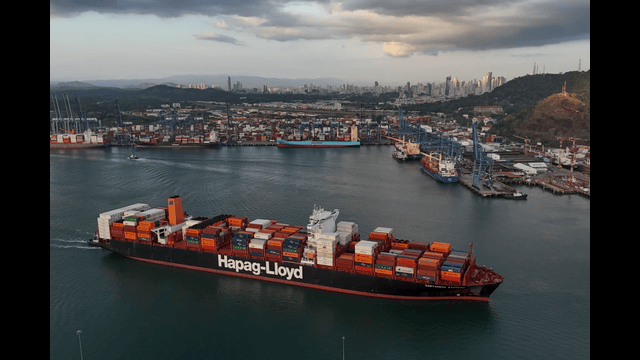
A cargo ship sails past the Panama Canal’s Port of Balboa, managed by CK Hutchison Holdings, in Panama City, March 13, 2025
Panama has pushed back strongly after criticism from China.
President José Raúl Mulino said Panama will not bow to foreign threats.
His comments followed rising tensions over a major Panama Canal court ruling.
The decision affects port operations linked to a Hong Kong-based company.
Mulino spoke during his regular Thursday morning briefing.
He said Panama hopes the dispute will not escalate further.
However, he made clear the government will defend its institutions firmly.
According to Mulino, national dignity is not negotiable.
Panama Stands Firm on Sovereignty
“Panama is a dignified country,” Mulino told reporters.
He said no nation has the right to intimidate Panama.
The president was responding directly to warnings from Beijing.
China had criticized Panama after the controversial court decision.
Mulino stressed that the matter is strictly legal.
He said Panama’s government respects judicial independence.
The ruling, he added, must be followed without external pressure.
Supreme Court Triggers Global Reaction
The tension began with a Supreme Court verdict last week.
Judges ruled that a key port concession was unconstitutional.
The concession was held by a subsidiary of CK Hutchison Holdings.
The Hong Kong-based firm has operated ports near the Panama Canal.
The Panama Canal court ruling immediately drew global attention.
The canal is one of the world’s most strategic trade routes.
Any decision affecting its ports carries international consequences.
U.S. Applauds, China Pushes Back
The ruling was widely seen as a win for U.S. interests.
President Donald Trump has openly opposed Chinese influence near the canal.
Washington has pushed Panama to reassess foreign control over port infrastructure.
China responded with sharp criticism.
Beijing warned Panama could face “a heavy price.”
The warning added pressure to an already sensitive situation.
Panama now finds itself in a geopolitical tug-of-war.
The dispute reflects broader tensions between Washington and Beijing.
CK Hutchison Moves to Arbitration
CK Hutchison Holdings rejected the court’s decision.
The company said it strongly disagreed with the ruling.
On Wednesday, its subsidiary launched arbitration proceedings.
The legal move aims to challenge Panama’s decision internationally.
Analysts say arbitration could delay enforcement of the ruling.
It may also give the company time to explore alternatives.
Port Operations to Continue for Now
Despite the legal clash, port activity will not stop immediately.
Mulino said the ruling still needs to be formally executed.
He did not specify how long that process would take.
Until then, Panama’s Maritime Authority will cooperate with the company.
Operations at the ports will continue during this interim phase.
The goal is to avoid disruptions to canal traffic and trade.
Transition Plan After the Ruling
Once the concession officially ends, a transition will begin.
Mulino said a local Maersk subsidiary will take temporary control.
The Danish logistics giant will manage the ports during the interim.
This arrangement will remain until a new concession is awarded.
Panama plans to open a fresh bidding process.
Mulino said transparency and national interest will guide the process.
Global Deal Faces Delays
The Panama ports are part of a much larger transaction.
CK Hutchison plans to sell 43 global ports for $23 billion.
The buyers include U.S. investment firm BlackRock.
The deal was announced last March.
However, progress has slowed significantly.
The Panama Canal court ruling has complicated negotiations.
Geopolitical tensions have also played a role.
Relations between the U.S. and China remain strained.
Analysts See Legal Strategy at Play
Experts believe CK Hutchison is buying time.
Arbitration may delay final outcomes.
It also keeps options open for the global port sale.
For Panama, the message remains clear.
Mulino says the country will uphold the rule of law.
Foreign pressure will not change the court’s decision.
As the dispute unfolds, the Panama Canal stays at the center.
Its future governance now reflects shifting global power dynamics.