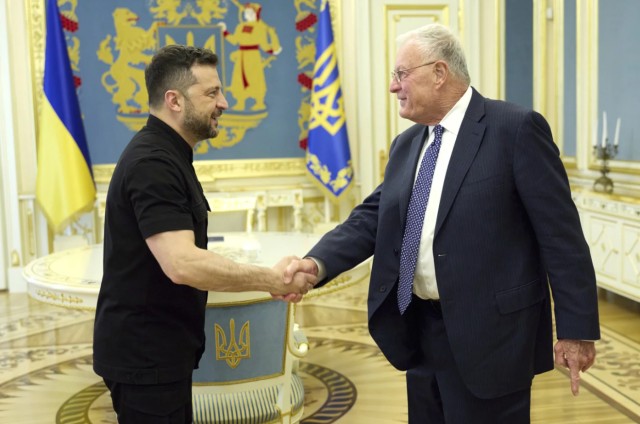
In this photo provided by the Ukrainian Presidential Press Office, Ukrainian President Volodymyr Zelenskyy, left, shakes hands with Keith Kellogg, Trump’s special envoy to Ukraine in Kyiv, Ukraine, Monday, Aug. 25, 2025.
U.S. President Donald Trump’s special envoy, Keith Kellogg, said in Kyiv that officials are “working very, very hard” to end the three-year Russia-Ukraine war. His comments come as doubts grow over whether a peace settlement is realistic anytime soon.
Kellogg, attending Ukraine’s National Prayer Breakfast, said discussions are underway on possible “security guarantees” to prevent another Russian invasion in the future. He admitted that these talks remain “a work in progress.”
Trump recently claimed he initiated steps toward direct peace talks between Russian President Vladimir Putin and Ukrainian President Volodymyr Zelenskyy. However, Russian officials have dismissed the possibility of such a summit happening soon.
Trump has said he will decide on next steps within two weeks if talks are not scheduled.
High-Level Visits Signal Urgency
Kyiv has seen a stream of high-ranking visitors in recent days, reflecting concern over stalled peace efforts.
Canadian Prime Minister Mark Carney visited on Sunday, pledging 2 billion Canadian dollars in aid. NATO Secretary General Mark Rutte also met with Zelenskyy on Friday.
On Monday, German Vice Chancellor and Finance Minister Lars Klingbeil arrived in Kyiv. He discussed ways Germany can support Ukraine during a potential peace process.
Putin Strengthens Alliances Elsewhere
While Western nations back Ukraine, Putin is deepening ties with allies.
The Kremlin said Putin spoke with Iranian President Masoud Pezeshkian on Monday. The two are expected to meet next week at the Shanghai Cooperation Organization summit in Tianjin, hosted by China.
Putin also continues to cultivate relations with China, India, and North Korea to offset Western support for Ukraine.
Germany and Norway Pledge Continued Support
Germany’s Klingbeil emphasized that Ukraine’s allies must prepare for the possibility that Putin may continue the war.
“Germany will stand by Ukraine,” he assured Zelenskyy, echoing support voiced earlier by Norwegian Prime Minister Jonas Gahr Store.
Store pledged long-term aid, saying Norway’s military and civilian support will extend into next year. He announced a proposal to spend $8.45 billion on Ukraine in 2025.
Norway, which borders Russia, stressed that Ukraine is defending a critical European principle by rejecting Russia’s territorial seizures.
On Sunday, Norway committed nearly 7 billion kroner ($695 million) for Ukrainian air defenses. Together with Germany, it will help fund two U.S.-made Patriot missile systems and additional radar support.
Analysts Warn of Putin’s Strategy
Military analysts believe Putin is betting on time. They argue he hopes Western governments will tire of funding Ukraine, allowing Russia to use its larger army to capture more territory while peace talks drag on.
Drone Strikes Escalate on Both Sides
Overnight, Russia launched 104 strike and decoy drones targeting Ukraine’s north and east. Ukraine reported no immediate casualties or damage.
Ukraine, meanwhile, has intensified long-range drone attacks on Russian infrastructure. Oil refineries, transport hubs, and armories have been hit, disrupting flights during peak summer travel.
On Sunday, an Egyptian plane carrying Russian tourists from Sharm El Sheikh to St. Petersburg was diverted to Tallinn after a drone threat forced St. Petersburg’s airport to close temporarily.
Russia’s Defense Ministry said it intercepted 23 Ukrainian drones overnight and Monday morning across seven regions, including areas deep inside Russian territory.
Peace Still a Distant Goal
The push for peace between Russia and Ukraine remains uncertain. While Trump’s envoy insists officials are working tirelessly, skepticism persists.
With ongoing drone strikes, hardened battle lines, and Putin strengthening global alliances, hopes for an immediate peace settlement remain slim.
Still, Ukraine’s allies, including Germany, Norway, and Canada, continue to provide financial and military support to Kyiv, determined to counter Russia’s aggression.