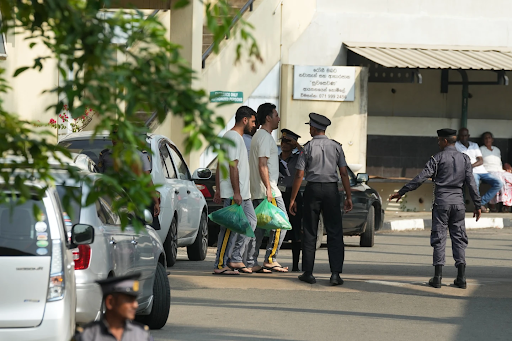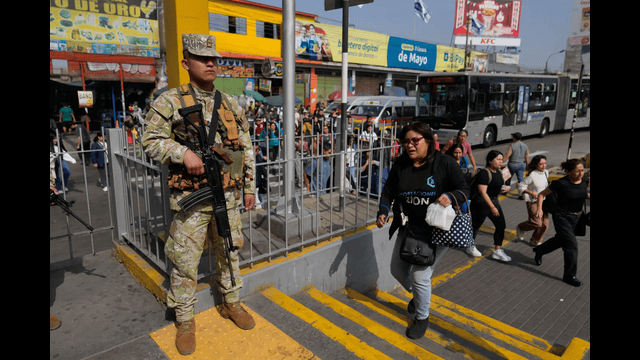
A soldier stands guard at a bus stop in Lima, Peru, Wednesday, Oct. 22, 2025, after President Jose Jeri declared a state of emergency.
Lima’s streets saw increased military and police presence on Wednesday. The heavy patrols marked the first day of a state of emergency declared by Peru’s new President José Jerí. The decree aims to curb rising crime in the country’s capital.
The sweeping measure suspends multiple constitutional rights. Freedom of assembly and public protest are temporarily restricted. Daily activities, such as two adults riding on the same motorcycle, are banned. Prison visits are limited, and authorities may cut power in cells, except for lighting.
Jerí assumed the presidency on October 10, following the removal of former President Dina Boluarte. Lawmakers cited her inability to control crime as a key reason for her ouster. The new president issued the state of emergency after violent protests erupted demanding his resignation. Police reportedly killed one protester, while another suffered a severe skull fracture during clashes.
Public Doubts Effectiveness
Despite the government’s strong stance, many Peruvians remain skeptical. Citizens recall previous emergency measures that failed to reduce crime significantly.
“There have already been several states of emergency. The extortions continue, the murders do not stop,” said Manuel Timoteo, a Lima resident waiting for a bus. “The soldiers appear for a few days, stand with their rifles, and then leave. Everything stays the same.”
Boluarte’s administration declared a similar emergency in March. That measure was extended until May but drew criticism for its ineffectiveness. Criminal groups continued extorting small businesses and attacking public transport workers. In some cases, violence occurred in front of passengers, highlighting the limits of the government’s approach.
Rising Crime in Peru
Crime rates in Peru have escalated in recent years. Homicides increased from 676 in 2017 to 2,082 in 2024. Extortion complaints rose sharply from 2,305 in 2020 to 21,746 last year. Working-class citizens are among the primary victims.
Experts say the rise in criminal activity has fueled public frustration and diminished trust in government interventions. Repeated emergency measures, while temporarily visible, have not led to lasting improvements.
President Jerí’s Challenge
President Jerí faces a daunting task. He must demonstrate that his approach can tackle organized crime more effectively than his predecessor. Analysts note that merely deploying soldiers and police for short periods is unlikely to address systemic issues.
Authorities have emphasized stricter penalties for criminal groups and more aggressive law enforcement. However, residents question whether these steps will translate into real safety improvements.
Streets Under Watch
On Lima’s northern avenues, military and police personnel patrol continuously. Armed forces stand at intersections, while police monitor major public spaces. Yet locals report little change in day-to-day security, underscoring the challenge of restoring public confidence.
Observers suggest that sustained and strategic interventions, beyond emergency declarations, are needed. Long-term solutions may include better coordination between police, community programs, and reforms targeting organized crime.
As Peru navigates this new state of emergency, the country’s citizens are watching closely. They hope for meaningful reductions in crime rather than temporary displays of authority. Only time will reveal if Jerí’s measures will deliver tangible results or repeat past failures.