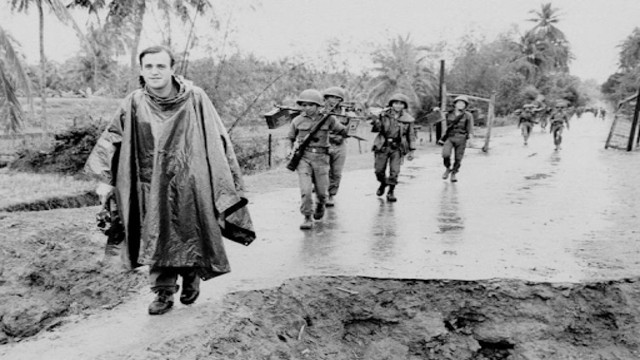
Peter Arnett, left, marches with Vietnamese troops in Vietnam, Nov. 11, 1965. (AP Photo)
Peter Arnett, the Pulitzer Prize-winning war correspondent whose reporting brought the brutal realities of conflict into homes around the world, has died at the age of 91. Known for his calm voice under fire and fearless frontline reporting, Arnett covered some of the most defining wars of the 20th century.
He died on Wednesday in Newport Beach, California, surrounded by family and friends, according to his son Andrew Arnett. He had been battling prostate cancer.
A Career Shaped By Conflict
Arnett built his reputation by reporting directly from war zones, often placing himself in extreme danger. From the jungles of Vietnam to the missile-lit skies over Baghdad, his eyewitness accounts reshaped how global audiences experienced war.
In 1966, he won the Pulitzer Prize for international reporting for his coverage of the Vietnam War with The Associated Press. The award recognised his ability to combine factual precision with powerful storytelling.
Colleagues remembered him as both fearless and deeply thoughtful. Edith Lederer, a fellow AP correspondent in Vietnam, called him one of the greatest war reporters of his generation.
From Wire Reporter To Global Face
For much of his early career, Arnett was best known within journalistic circles. He reported from Vietnam from 1962 until the fall of Saigon in 1975, filing detailed dispatches that captured both combat and its human cost.
His global fame came later. During the 1991 Gulf War, Arnett became a household name after delivering live reports for CNN from Baghdad.
While most Western journalists had evacuated before the U.S.-led bombing began, Arnett stayed behind. As missiles struck the city, he broadcast live from his hotel room using a cellphone.
His calm, New Zealand-accented voice described explosions, damaged infrastructure, and air-raid sirens echoing in the background. The broadcasts were unprecedented and widely watched.
Close Calls On The Battlefield
Arnett’s career was marked by repeated brushes with death. One of the most striking occurred in January 1966 while embedded with U.S. troops in Vietnam.
Standing beside a battalion commander studying a map, Arnett witnessed the officer shot dead by a sniper. Bullets tore through the map and into the colonel’s chest, just inches from Arnett’s face.
He later wrote the fallen officer’s obituary, opening with a vivid reflection on how rank and fate can vanish in war. The passage became one of his most remembered pieces of writing.
Learning To Survive The Front Lines
Arnett often credited his survival to lessons learned early in Vietnam. At the AP’s Saigon bureau, he worked alongside some of the era’s most respected journalists.
Bureau chief Malcolm Browne and photo editor Horst Faas were among his mentors. Both would go on to win multiple Pulitzer Prizes.
From them, Arnett learned practical rules of survival. He avoided standing near medics or radio operators, knowing they were prime targets. He also learned never to look toward incoming gunfire.
These instincts kept him alive through decades of conflict reporting.
A Career Not Without Controversy
Before Vietnam, Arnett served briefly as AP’s Indonesia correspondent. That assignment ended abruptly after he reported the country’s economy was collapsing.
The Indonesian government expelled him, marking the first of several controversies in his career. Despite criticism and political pressure at different points, Arnett continued reporting without retreat.
Those moments, colleagues said, only strengthened his resolve to document events as he saw them.
Preserving History Beyond The Headlines
As the Vietnam War neared its end, AP headquarters instructed Arnett to destroy bureau documents. He refused.
Instead, he shipped the papers to his New York apartment, convinced they held long-term historical value. Today, those records form part of the AP’s archives.
The decision reflected his belief that journalism was not just daily reporting, but a record for future generations.
A Lasting Legacy
Peter Arnett’s reporting helped define modern war correspondence. He showed that calm narration, accuracy, and moral clarity could coexist even amid chaos.
His work continues to influence journalists, historians, and audiences worldwide.
For decades, he bore witness where others could not. His voice, steady under fire, remains one of the most enduring sounds of wartime journalism.