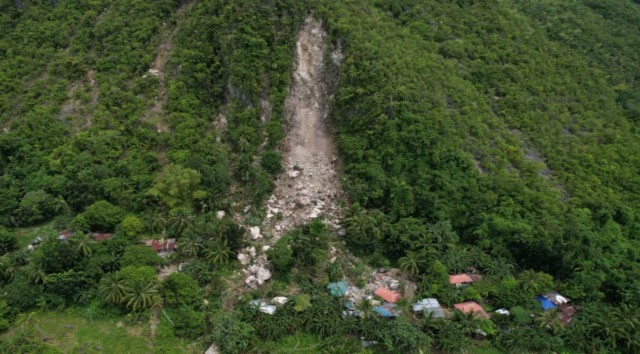
Damaged homes lie after a landslide caused by Tuesday’s strong earthquake killed some people sleeping in their hillside homes, Thursday, Oct. 2, 2025, in Bogo city, Cebu Province, Central Philippines.
A devastating 6.9-magnitude earthquake struck the central Philippines on Tuesday night, claiming at least 72 lives and injuring more than 360. The coastal city of Bogo in Cebu province bore the brunt of the destruction. Residents recount harrowing moments as buildings collapsed around them.
Parents’ Heartbreaking Loss
For Isagani Gelig, the earthquake became a nightmare. Firefighters recovered the body of his 4-year-old son from the rubble of the Condor Pension House. Moments later, rescuers brought out the body of his wife, the hotel’s night receptionist. Both had been trapped under debris. Gelig gently touched the cadaver bags, trying to feel their presence one last time.
“I went around the rubble and kept calling their names,” he told The Associated Press, standing near the ruins where their remains were found together on the first floor.
Widespread Damage Across Bogo
The quake damaged or destroyed 87 buildings and nearly 600 houses in Bogo and surrounding towns. Bridges, roads, and the city’s seaport also suffered severe damage. Over 170,000 people were affected, many too traumatized to return home. Search and rescue efforts officially ended as officials confirmed no additional missing persons.
The earthquake occurred around 10 p.m., triggered by a shallow undersea fault line. Filipino seismologists noted this fault had not moved in at least 400 years.
Government Response and Aid
President Ferdinand Marcos Jr. visited Bogo Thursday. He inspected the destruction, offered medical and financial aid, and comforted grieving families. Tents are being set up to shelter displaced residents. Just days prior, the president had toured the central region after a powerful storm killed at least 37 people.
International support poured in. The United States offered assistance, while Japan, China, and other countries sent condolences. Japanese Prime Minister Shigeru Ishiba said, “Japan always stands with the Philippines in overcoming this time of difficulties.”
Life-Saving Heroes Lost
The Red Cross shared tragic stories of volunteers caught in the disaster. Ian Ho, a 49-year-old full-time volunteer, died in the rubble with his 14-year-old son, whom he shielded during the collapse. “He chose to be the shield of his son,” Red Cross Secretary-General Gwendolyn Pang said.
Survivors Recall the Chaos
Bryan Sinangote, 49, was at a basketball game in nearby San Remigio town when the earthquake struck. The gym’s ceiling collapsed, killing three coast guard personnel and a firefighter. Sinangote was partially trapped but rescued and treated for injuries.
Survivors noted the recurring threat of natural disasters in the Philippines. Sinangote recalled Typhoon Haiyan in 2013, which left over 7,300 dead or missing and destroyed entire villages. “It’s heartbreaking to hear what happened to Bogo city. We just have to be prepared for anything,” he said.
A Nation on the Pacific “Ring of Fire”
The Philippines is one of the world’s most disaster-prone countries. Earthquakes, volcanic eruptions, and about 20 typhoons annually make emergency preparedness critical. Communities rely heavily on government response teams and volunteer groups to recover after each calamity.
As Bogo begins to rebuild, survivors continue to mourn their lost loved ones. The city now faces the challenge of restoring infrastructure, homes, and a sense of security while remembering those who perished in the quake.