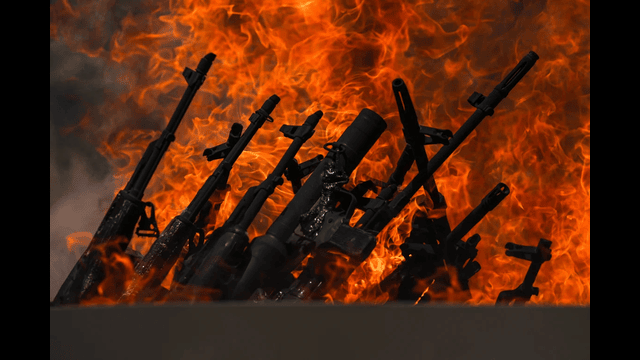
PKK weapons being destroyed in Sulaymaniyah, northern Iraq, on July 11, 2025.
In a historic ceremony in northern Iraq, fighters from the Kurdistan Workers’ Party (PKK) laid down their arms, marking what could be the beginning of the end to a decades-long conflict with Turkey. The gesture was small in scale but massive in symbolism, offering a hopeful glimpse of peace after nearly 50 years of bloodshed.
Fire Signals New Chapter in Turkey-PKK Conflict
The ceremony took place in the ancient Casene cave near Sulaymaniyah. Around 30 PKK members, both men and women, placed their weapons into a large metal cauldron and set them on fire. This act, conducted in front of a small group of invited observers, was a powerful visual representation of their intent to abandon armed struggle.
In a written statement, the militants declared:
“We hereby, of our own free will, and in your presence, destroy our weapons.”
They emphasized a shift in their approach, vowing to continue their “struggle for freedom” through “democratic politics and legal means.”
Turkish Officials Call It a Milestone
Though journalists weren’t permitted at the event, Turkish news channels aired dramatic coverage. Helicopters flew over the site, and convoys of white pick-up trucks and black vans were seen heading to the area.
A senior Turkish official called the move an “irreversible turning point” in Turkey’s efforts to end the conflict. President Recep Tayyip Erdogan also praised the development, calling it “an important step on our path to a terrorism-free Turkey.”
On X (formerly Twitter), Erdogan wrote:
“May Almighty God grant us success in achieving our goals on this path we walk for the security of our country, the peace of our nation, and the establishment of lasting peace in our region.”
Regional Support for Disarmament
The Iraqi foreign ministry welcomed the PKK’s action. In a statement, it called the event a “significant development” and a “concrete beginning toward disarmament.”
This ceremony followed a May announcement by the PKK that it would halt all activities and disband. The decision came after an appeal from its imprisoned founder, Abdullah Ocalan. At the time, the PKK stated the Kurdish issue had reached a stage where it could be resolved through democratic means.
In a rare video message this week, Ocalan urged the Turkish parliament to form a special commission to oversee the peace process.
Decades of Violence and Unfinished Peace
The PKK was founded by Ocalan in 1978. Initially, it fought for an independent Kurdish state in southeastern Turkey. In recent years, however, the group shifted its focus toward seeking autonomy and cultural rights within the Turkish state.
The long-running conflict between Turkey and the PKK has claimed over 40,000 lives. Multiple peace efforts have collapsed over the years. Erdogan, who once sought to win Kurdish support by lifting cultural restrictions, tried negotiating peace in 2013. Those talks broke down in 2015.
Since then, Turkish authorities have intensified crackdowns on pro-Kurdish political parties. Selahattin Demirtas, a former presidential candidate and co-leader of the pro-Kurdish Peoples’ Democratic Party (HDP), remains in prison on vague charges. Human Rights Watch has criticized his detention as unjust and politically motivated.
Kurds Remain a Key Minority in Turkey and the Region
Kurds make up an estimated 15–20% of Turkey’s population, making them the country's largest ethnic minority. Their presence also extends to northern Syria, Iraq, and Iran, where Kurdish communities continue to advocate for greater autonomy and rights.
While this symbolic disarmament does not end the conflict overnight, it signals the strongest commitment yet to a peaceful resolution. For a country that has seen decades of turmoil, the sight of weapons burned in Casene’s cave offers a flicker of lasting hope.