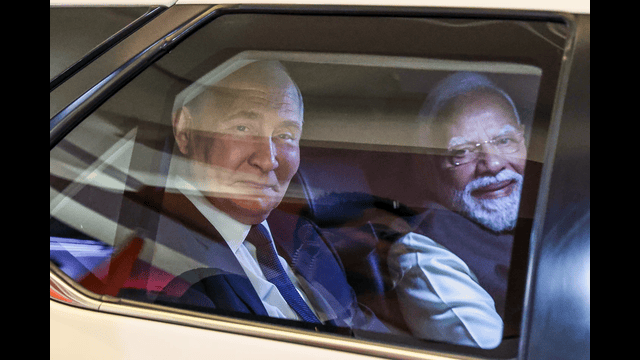
Russian President Vladimir Putin and Indian Prime Minister Narendra Modi sit inside a car that arrives at the Indian Prime Minister's office in New Delhi.
Russian President Vladimir Putin and Indian Prime Minister Narendra Modi meet on Friday for the 23rd Russia-India Summit, a high-stakes dialogue centered on strengthening trade, defense cooperation and energy ties. The meeting comes as Washington increases pressure on global partners to support a Ukraine peace deal, placing New Delhi in a delicate diplomatic balancing act.
A Warm Welcome Signals Strong Bilateral Intent
Putin arrived in New Delhi on Thursday, where Modi greeted him with a warm hug and a firm handshake. The camaraderie highlighted the long-standing strategic partnership between Russia and India despite intensifying US pressure and global tensions linked to the Ukraine conflict.
Indian officials confirmed that the summit agenda includes defense cooperation, energy security, labor mobility, and measures to boost bilateral trade.
Balancing Moscow and Washington
The Putin-Modi meeting unfolds at a sensitive time. The United States continues to urge countries to limit ties with Moscow, arguing that Russian oil purchases help fund its war efforts.
India has become the second-largest buyer of Russian crude after China, largely due to discounted prices. This prompted US President Donald Trump to impose steep 50% tariffs on Indian goods in August, citing India’s reliance on Russian energy.
Washington also sanctioned two major Russian oil producers in October in an attempt to force partners, including India, to reduce imports.
Indian officials maintain that New Delhi respects all international sanctions and will continue doing so, including in the case of Russian oil.
Trade Negotiations Under Strain
India and the US had set a goal to finalize the first phase of a trade agreement this fall, but talks remain stalled amid diplomatic friction.
At the same time, India is closing in on a major trade pact with the European Union, which views Russia’s war in Ukraine as a critical security threat. Some critics argue that Putin’s visit may complicate India’s relationship with both Washington and Brussels, potentially affecting market access and export growth.
Defense Ties Dominate the Agenda
Defense cooperation remains a cornerstone of the Russia-India relationship. Modi is expected to push for faster delivery of two pending S-400 missile systems, part of a larger $5.4 billion deal signed in 2018. Three systems have already been delivered, but the remaining units have been delayed due to supply chain disruptions linked to the war.
Both nations recently ratified a pact to deepen military exercises, logistics support, port calls, and disaster-relief coordination.
Talks may also cover upgrades to India’s Su-30MKI fighter jets and the accelerated delivery of other key military hardware.
Trade Targets and Economic Goals
Bilateral trade reached $68.7 billion last fiscal year, with a shared goal of hitting $100 billion by 2030. However, India faces a significant trade deficit due to heavy imports of oil, defense equipment, and fertilizers from Russia.
New Delhi aims to expand exports of pharmaceuticals, agricultural products, and textiles to reduce the imbalance. India is also pressing Moscow to remove non-tariff barriers that limit market access.
Long-term fertilizer supply agreements are another priority, given India’s dependence on Russian producers.
Mobility Agreement for Skilled Workers
A major milestone expected during the summit is an agreement on safe and regulated migration of Indian skilled workers to Russia. Labor mobility has become increasingly important as both countries explore wider economic cooperation.
A Relationship Built Over Decades
Putin last visited India in 2021, while Modi traveled to Moscow in 2023. The leaders also held a brief discussion in September during a Shanghai Cooperation Organization summit in China.
As geopolitical tensions rise, the Putin-Modi summit will test India’s ability to protect strategic autonomy while navigating competing expectations from Russia and the United States.
The outcome of today’s talks could shape India’s foreign policy, defense strategy, and trade trajectory for years to come.