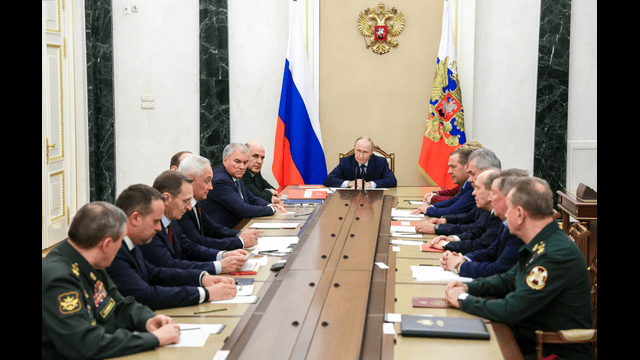
Russian President Vladimir Putin chairs a meeting with the members of the Security Council in Moscow, Russia.
Russian President Vladimir Putin has instructed his top officials to prepare proposals for a possible resumption of nuclear tests. The move follows recent comments by U.S. President Donald Trump, who suggested that Washington could restart its own nuclear testing program after three decades.
Putin Responds to Trump’s Nuclear Remarks
During a Security Council meeting on Wednesday, Putin reiterated that Russia will only resume nuclear testing if the U.S. acts first. However, he directed the Defense and Foreign Ministries to closely monitor Washington’s intentions and outline possible steps for Russia’s next actions.
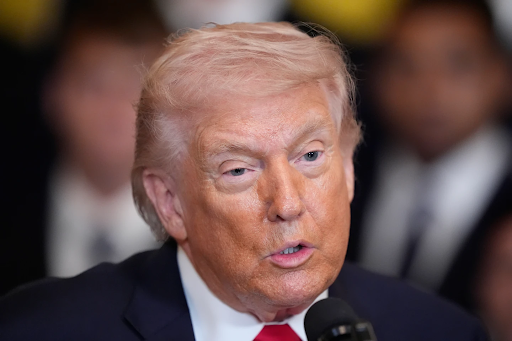
Putin’s directive comes days after Trump’s October 30 statement, where he hinted that the U.S. could begin testing “on an equal basis” with Russia and China. The comment raised global alarm over the potential end of the decades-long moratorium on nuclear detonations.
Conflicting U.S. Signals Add to Tension
Despite Trump’s statement, U.S. Energy Secretary Chris Wright clarified that the planned tests would not involve nuclear explosions. He emphasized that the testing program would focus on system evaluations, not detonations.
Trump made the announcement on social media during his visit to South Korea, shortly after Putin celebrated Russia’s successful trials of nuclear-capable and nuclear-powered cruise missiles and underwater drones. These demonstrations, which Putin described as “impossible to intercept,” were widely seen as a message to Washington amid rising tensions over Ukraine.
The Nuclear Test Ban Treaty Divide
The Comprehensive Nuclear Test Ban Treaty (CTBT), adopted in 1996, prohibits all nuclear explosions. While the U.S. signed but never ratified the treaty, it has voluntarily observed its terms since 1992. Russia had ratified the CTBT but revoked its ratification in 2023, arguing it was necessary to maintain strategic parity with the United States.
Moscow’s move to withdraw from the treaty was widely interpreted as a signal that it could resume testing if provoked.
Russian Military Urges Swift Action
During the Security Council meeting, Defense Minister Andrei Belousov briefed Putin on what he described as “U.S. efforts to modernize its nuclear arsenal.” He warned that such activities, combined with Trump’s remarks, increased military threats to Russia.
Belousov proposed that Moscow begin preparations for nuclear tests on the Novaya Zemlya archipelago, a site in the Arctic where the Soviet Union last conducted a nuclear test in 1990. He assured that the facility is technically ready for renewed activity.
Backing this stance, Gen. Valery Gerasimov, Chief of the General Staff, cautioned that any delay could hinder Russia’s ability to respond effectively.
“If we don’t act now, we could lose valuable time,” Gerasimov said, emphasizing that test preparations could take months or even years.
Putin Orders Caution, Not Immediate Tests
After listening to his defense and security officials, Putin instructed government agencies to collect detailed intelligence on U.S. actions and submit coordinated proposals for possible testing scenarios.
Kremlin spokesperson Dmitry Peskov later clarified that Putin’s order does not mean Russia will immediately resume nuclear testing. He said the president’s directive is a precautionary measure, aimed at understanding whether such action would be necessary.
“Moscow must fully grasp U.S. intentions before making a decision,” Peskov told the state-run Tass news agency.
Medvedev: “Russia Must Take Trump Seriously”
Dmitry Medvedev, Deputy Chairman of the Security Council, later commented on social media that Trump’s words cannot be ignored, even if they were unclear.
“No one knows what Trump meant about ‘nuclear testing’—perhaps not even he does,” Medvedev wrote on X.
“But as the U.S. president, his statements have consequences. Russia must now assess whether it’s time to resume full-fledged nuclear tests.”
A New Nuclear Standoff?
Putin’s latest move underscores a growing climate of nuclear uncertainty between the U.S. and Russia—the two nations with the largest atomic arsenals. While both sides have so far avoided crossing the line into actual testing, the renewed rhetoric risks undoing decades of arms control progress.
With tensions over Ukraine still simmering and global trust in arms treaties weakening, analysts warn that the return of nuclear testing could mark a new Cold War-style escalation—one with unpredictable consequences for global security.