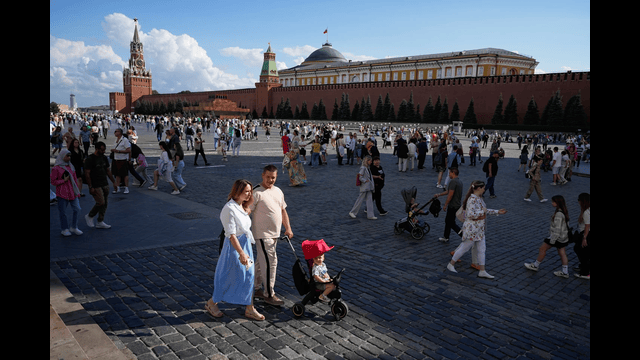
A family walks through Red Square in Moscow, Russia.
For over two decades, President Vladimir Putin has struggled against one of Russia’s biggest long-term threats — a shrinking and aging population. Despite repeated promises and incentives to boost birth rates, the country’s demographic decline continues to accelerate.
Putin’s Long Battle With Population Decline
Russia’s birth rate crisis began even before Putin rose to power. In 1999, the country recorded its lowest-ever number of newborns. When Putin became president, he vowed to reverse the trend by ensuring “social and economic stability.”
Yet, years later, the issue still haunts the Kremlin. Speaking at a demographic conference in 2025, Putin once again called population growth “crucial” for Russia’s future.
Over the years, he has introduced numerous initiatives — from free meals for large families to the revival of Soviet-style “Hero Mother” medals for women with ten or more children. “Let’s preserve and revive the tradition of large families,” Putin said last year.
Initially, the strategy appeared to work. Births rose from 1.21 million in 1999 to 1.94 million in 2015. But since then, Russia’s demographic picture has worsened sharply.
Birth Rates Fall, Deaths Rise
Financial instability, war in Ukraine, and the exodus of young Russians have all contributed to the decline. Russia’s population fell from 147.6 million in 1990 to 146.1 million in 2025, according to official data — even after including Crimea’s population in the count.
The population is also aging rapidly. In 1990, about 21% of Russians were over 55. By 2024, that figure had climbed to 30%.
Since 2015, births have fallen every year, while deaths continue to outnumber them. In 2024, only 1.22 million babies were born — nearly as low as the 1999 record. Demographer Alexei Raksha even reported that February 2025 saw the fewest monthly births in over 200 years.
Restrictive Laws and “Traditional Values”
The Kremlin has responded with restrictive social policies that promote “traditional family values.” These include banning “child-free propaganda,” outlawing LGBTQ+ activism, and discouraging abortion.
Officials argue that restoring traditional norms will strengthen the nation. But critics, like feminist scholar Sasha Talaver, say these measures pressure women to become mothers “in the name of patriotism.”
While Russia still legally allows abortion, access has become increasingly limited. Many private clinics no longer perform the procedure, and new rules restrict abortion pills. Mandatory waiting periods and counseling sessions can delay access until it’s too late for a legal termination.
Although abortion numbers have declined, the change hasn’t led to more births. Activists warn that restricting reproductive rights will only lead to unsafe abortions and put more women’s lives at risk.
Historical and War-Related Setbacks
Russia’s demographic troubles have deep historical roots. The Soviet Union’s losses in World War II — about 27 million deaths — left deep scars on the population structure.
Later, the Soviet collapse in the 1990s triggered another drop in births. Now, the war in Ukraine is worsening the situation. Western estimates suggest hundreds of thousands of Russian soldiers have died, while many young men and women have fled abroad to escape repression or conscription.
“The pool of potential mothers and fathers has shrunk dramatically,” said Jenny Mathers, a Russian studies expert at Aberystwyth University. “That’s a serious concern for Putin, who ties national security to population growth.”
Incentives and Symbolism
To encourage families, the government has introduced various incentives. These include cash certificates for parents that can be used for housing or education. Some regions even offer one-time payments to teenage mothers, a move critics say could encourage early pregnancies.
Other efforts are largely symbolic — such as new holidays like Family, Love and Fidelity Day and Pregnant Women’s Day. Yet, none of these seem to have reversed the downward trend.
Russia’s fertility rate currently stands at just 1.4 children per woman — far below the replacement level of 2.1.
Immigration and the Future
Experts say immigration could help offset population losses. But rising anti-migrant sentiment and tighter restrictions have made that unlikely. The Kremlin has cracked down on migrant workers, tracked their movements, and limited their children’s access to education.
Central Asian workers, once vital to Russia’s labor force, are now seeking jobs elsewhere to escape discrimination and economic instability.
As the war drags on, economic uncertainty continues to erode hope. “When people don’t believe in their future, they don’t plan families,” Mathers said.
A 29-year-old Moscow woman who chose not to have children agrees. “A healthy child can only grow up in a happy family,” she said. “And that’s not something Russia can promise right now.”