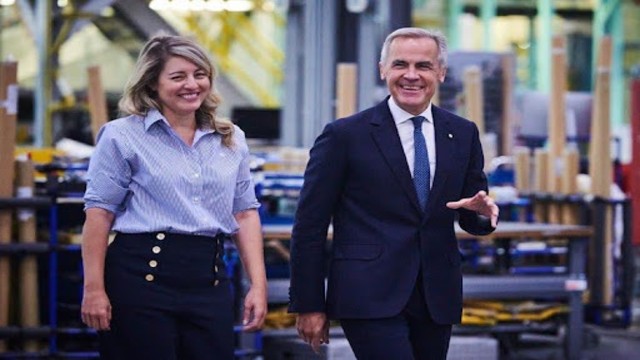
Prime Minister Mark Carney and Industry Minister Mélanie Joly walk through a manufacturing facility. Image: The Canadian Press
Quebec’s aluminum industry is on track to receive a significant boost from Ottawa’s new tariff relief fund. Federal Industry Minister Mélanie Joly says the sector could secure “hundreds of millions of dollars” from a $5-billion package unveiled last week.
The announcement offers hope for an industry hit hard by U.S. tariffs that continue to squeeze profits and global competitiveness.
Billions to Ease Tariff Pressures
The federal government launched a $5-billion fund to help industries battered by trade disputes with the U.S. The package includes tariff relief, a “Buy Canadian” procurement policy, and $1 billion earmarked for small and medium-sized businesses.
Prime Minister Mark Carney emphasized that the fund isn’t limited to large industries alone. Regional businesses across Canada will also benefit from targeted support, ensuring relief reaches every corner of the country.
Aluminum at the Heart of the Plan
Nearly all Canadian aluminum comes from Quebec, making the province central to this support. At a Montreal press conference, Joly highlighted ongoing talks with major players like Alcoa, Rio Tinto, and Alouette.
“These projects alone represent hundreds of millions,” Joly said. She stressed the government’s commitment to ensuring the industry receives its “fair share” from the fund.
Heavy Reliance on the U.S. Market
Jean Simard, president of the Aluminum Association of Canada, joined Joly at the announcement. He underscored how deeply the industry depends on the U.S.
In 2024, Canada produced 3.3 million tonnes of aluminum—its highest output ever. About 90 percent was exported, and nearly all of that went south of the border.
“The U.S. is our biggest customer. Cutting ties isn’t an option,” Simard explained.
Searching for New Markets
Although Canadian producers have started shipping more aluminum to Europe, it’s not enough to offset U.S. tariffs. Simard noted that while Asia and Europe offer potential growth, abandoning the U.S. would open the door for competitors.
“As U.S. prices rise, other producers would simply fill the gap,” he warned.
Wider Economic Strategy
Carney reinforced the message during a separate event in St. John’s, where he unveiled $80 million for small and medium-sized businesses in Atlantic Canada. He said trade tensions are affecting regions differently, depending on their industry mix.
“Even businesses not directly hit by tariffs are feeling the ripple effects,” Carney said.
The prime minister added that the government’s push for efficiency in federal spending will create fiscal room for more investment in businesses. The first federal budget under his leadership is expected this fall.
Regional Rollout of Support
Federal ministers are traveling across Canada to highlight details of the tariff response fund, officially called the regional tariff response initiative. The fund will be administered through regional development agencies to ensure tailored support.
Ottawa has already committed $150 million for steel producers, announced earlier this summer. Aluminum now joins steel as a key priority sector for tariff relief.
A Lifeline for a Strategic Industry
For Quebec’s aluminum producers, the promised “hundreds of millions” could provide breathing space in an uncertain trade climate. With production at record highs but profits under pressure, the industry is counting on federal support to remain globally competitive.
Joly summed up the government’s stance simply: “Quebec’s aluminum sector will get its fair share.”