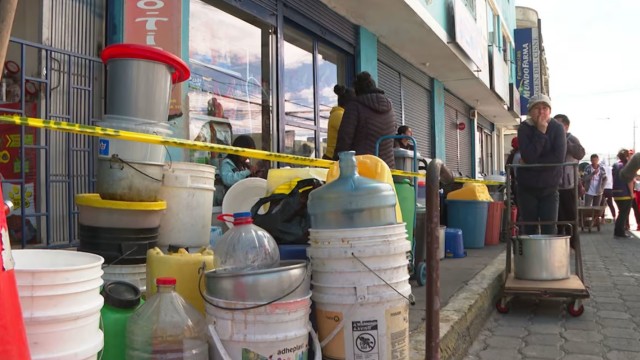
People in Quito, Ecuador, wait for a tanker to deliver water.
Quito, the capital of Ecuador, is currently reeling from its worst water crisis in 25 years. A massive landslide severely damaged a crucial pipeline, leaving over 400,000 residents—especially in the southern part of the city—without access to clean drinking water.
The disruption has brought daily life to a halt. People are lining the streets with buckets, jugs, and washbasins, desperately awaiting water tankers that are stretched thin. Tempers are rising, and so is the pressure on the local and national governments to act swiftly.
Water Tankers Can't Keep Up
The municipality has deployed around 71 tankers to the affected areas. But for many residents, that’s far from enough. Water deliveries are erratic and often delayed, leaving citizens stranded in long queues under the scorching sun.
In Chillogallo, one of the hardest-hit neighborhoods, 74-year-old Inés Castro waits alone on the sidewalk.
“We’ve been waiting since morning,” she says, her voice cracking. “I live alone. I just hope someone helps me carry the water home.”
Another resident, Erselinda Guilca, adds, “We’re old and sick. We can’t carry heavy buckets. We need a solution now. I’d rather lose electricity than water.”
Older Adults Bear the Brunt
The crisis is hitting the elderly the hardest. Most are forced to fetch water on their own, often with no assistance or clear schedule to rely on. People like Elsa Sarango bring kitchen pots and plastic tubs, standing in long queues with hopes of just a little water.
“They don’t tell us when the tankers are coming. It’s exhausting,” Sarango says. “And our sanitation needs are only growing.”
Unsafe Water, A Risky Alternative
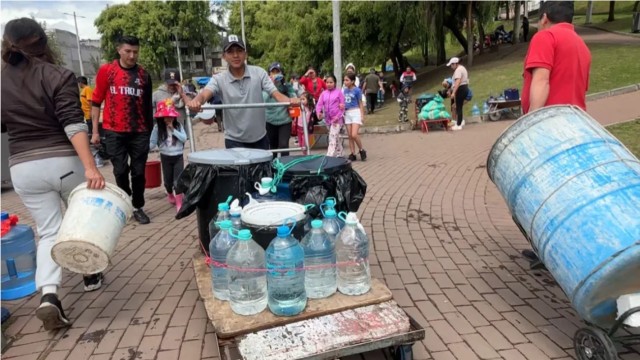
In neighborhoods like Nueva Aurora, desperation is pushing people to unsafe options. Residents are collecting water from untreated springs in parks—sources that don’t meet safety or purification standards.
Some walk long distances, while others use makeshift carts, bikes, or vehicles to carry containers. The water may not be drinkable, but for many, it’s the only option to flush toilets or wash dishes.
Bricklayer Tomás Chiguano shares his struggle: “I carry water in garbage bags because I have no containers. Sometimes, the bags tear. My work is also suffering—I can’t mix cement without water.”
To address the looming health threat, the government has set up its first portable water treatment plant in the area.
Water Access Is Becoming Expensive
Residents are also burdened by the hidden costs of water access. Many are paying drivers $2 to $5 USD to help transport containers. Others make multiple trips a day, increasing physical and financial strain.
“I make seven or eight trips daily just to fetch water,” says María Tipán. “And I still can’t wash my grandchildren’s clothes. It’s becoming too expensive.”
Mounting Tensions Between Governments
Local and national authorities are locked in a blame game.
Mayor Pabel Muñoz claims his office is working tirelessly to resolve the emergency. Over 500 workers are removing sludge and debris, and he expects service to resume by Sunday.
“This is Quito’s most serious water crisis,” Muñoz said. “We’re working day and night, both in the páramo and in the neighborhoods.”
Meanwhile, Vice President María José Pinto has taken charge of coordinating emergency aid at the national level. The National Emergency Operations Committee (COE), in collaboration with the Ecuadorian Red Cross, has installed three mobile purification units.
But COE President Inés Manzano criticized the local government’s response. “There’s been no crisis plan, no timely technical report. We had to step in.”
Mayor Muñoz pushed back, highlighting a lack of coordination. “Why hasn’t the national government contacted us? Why aren’t they present at the Unified Command Post?”
President Noboa Silent Amid Unrest
President Daniel Noboa has not publicly addressed the crisis.
His silence is drawing criticism from civil society groups already frustrated by his government's lack of focus on social issues.
While Noboa prioritizes national security and the crackdown on crime, Quito’s residents are left to battle a growing humanitarian crisis—one bucket of water at a time.
The coming days will be crucial as authorities scramble to restore water and public trust. Until then, the people of Quito continue to wait—thirsty, exhausted, and uncertain.