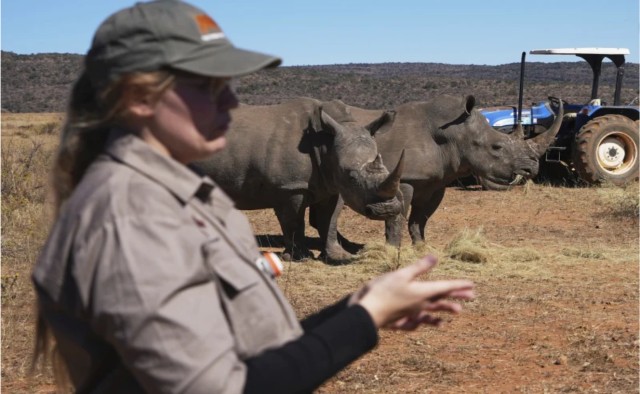
Rhinos are photographed at a rhino orphanage in Mokopane, South Africa, Thursday, July 31, 2025.
In a bold move to protect endangered rhinos, South African scientists have launched a groundbreaking anti-poaching initiative. The project involves injecting radioactive isotopes into rhino horns, making them detectable at international borders without harming the animals.
Rhisotope Project: A Game-Changer in Wildlife Conservation
This innovative campaign, named the Rhisotope Project, was officially launched by the University of the Witwatersrand in collaboration with nuclear energy experts and conservationists. The aim is clear — deter illegal rhino horn trade by making smuggling nearly impossible.
Five rhinos have already undergone the procedure as part of the project’s initial phase. Researchers are now planning to expand the effort to cover more of the vulnerable population.
How Radioactive Rhino Horns Stop Poachers
Rhino horns are highly sought after in illegal markets, often used in traditional medicine and as status symbols. This demand has driven poaching to devastating levels.
But the radioactive isotopes being injected are changing the game. Although the radiation is at low levels, it can still be picked up by customs and border security systems globally. This means any horn illegally trafficked can be easily flagged and intercepted.
James Larkin, chief scientific officer for the Rhisotope Project, emphasized the safety of the method. “We’ve proven, beyond any scientific doubt, that the process is completely safe for the animal,” he stated. He also noted that even a single horn with low radiation levels triggered alarms in radiation detectors.
Successful Trials Prove the Science Works
This isn’t a sudden experiment. Last year, 20 rhinos underwent similar injections during the project’s trial phase. The trials were a success, with horns showing up on radiation detectors—even inside fully loaded 40-foot shipping containers.
These results gave researchers the confidence to expand the project on a national scale. “We now know it works in real-world scenarios,” said Larkin.
Rhino Numbers Dwindling at Alarming Rates
According to the International Union for Conservation of Nature (IUCN), the global rhino population has dropped dramatically. From about 500,000 at the start of the 20th century, numbers have plummeted to just 27,000 today.
South Africa is home to nearly 60% of the world’s rhinos, with around 16,000 still in the wild. However, the country loses approximately 500 rhinos each year to poachers. These figures highlight the urgent need for creative and effective solutions like the Rhisotope Project.
Collaboration is Key to Saving Rhinos
The University of the Witwatersrand is urging both private game reserves and national conservation authorities to adopt the technology. The hope is to build a united front against rhino poaching using science and innovation.
By injecting radioactive isotopes into more rhino horns, the country could dramatically reduce illegal horn trafficking. With every horn made traceable, the risk to poachers and smugglers increases—while rhinos gain a new layer of protection.
A Safer Future for Rhinos
This initiative could mark a turning point in the fight against wildlife crime. Radioactive rhino horns offer a high-tech way to tip the odds in favor of conservationists.
As efforts expand, scientists remain hopeful that this pioneering solution will not only protect South Africa’s rhinos but inspire similar strategies for other endangered species worldwide.