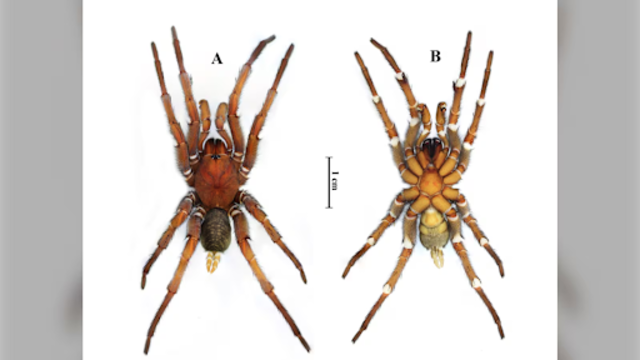
A male Damarchus inazuma spider is shown in this image from recent research describing a newly identified species in Thailand. CTV
Researchers in Thailand have uncovered a remarkable new spider species that stunned scientists for its rare physical trait — it is half male and half female. The discovery took place near a forest in Kanchanaburi province, in western Thailand, where the unusual creature caught the attention of a research team from Chulalongkorn University Museum of Natural History.
The team said the spider displays “gynandromorphism,” a condition that divides the body right down the middle, showing both male and female characteristics. This rare biological feature occurs in very few animal species, making this discovery especially important to science.
New Species with Striking Traits
After careful study, the researchers suggested that the spider likely belongs to the Damarchus genus, commonly known as wishbone or mygalomorph spiders. These spiders are usually found across South and Southeast Asia. However, the researchers said they still need more evidence to confirm the exact classification.
The team named the new species Damarchus inazuma, inspired by “Inazuma,” a character from the Japanese manga One Piece. In the story, Inazuma can change between male and female forms. The name reflects the spider’s split appearance, with distinct male and female features shown clearly on opposite sides of its body.
Colours Show the Split
The physical differences between the two sides of the spider are hard to miss. On one side, the spider appears bright orange, resembling the female. On the other, it looks white and grey like the male. The male half also has a thin white coating, while the female half does not.
The male measures about 1.5 centimetres long, while the female reaches nearly one inch. This contrast in size and colour mirrors the sexual differences seen in the species. Researchers described the spider as a fascinating example of natural asymmetry.
The Inazuma Design
In their paper, the scientists said, “The Inazuma style is characterized by bilateral asymmetry, presenting distinct coloration with orange on the left side and white on the right side.” They also explained that this unusual pattern reflects the two sexes’ typical colouring — white for males and orange for females.
These spiders live in underground burrows shaped like a wishbone, lined with silk. They often wait inside for insects or small creatures to come near before quickly ambushing their prey.
Understanding a Rare Phenomenon
The study also clarified that “gynandromorphs” differ from hermaphrodites. Hermaphrodites naturally have both male and female organs on each side of their bodies, while gynandromorphs show the two sexes divided down the middle. The researchers said gynandromorphism is extremely rare in the animal world.
“To confirm the presence of gynandromorphism, traits of both sexes, such as genitalia, must be present within the same individual,” the paper explained.
This discovery adds a valuable piece to the understanding of how rare biological variations appear in nature. Scientists hope further study will reveal how such unique spiders develop and survive in the wild.