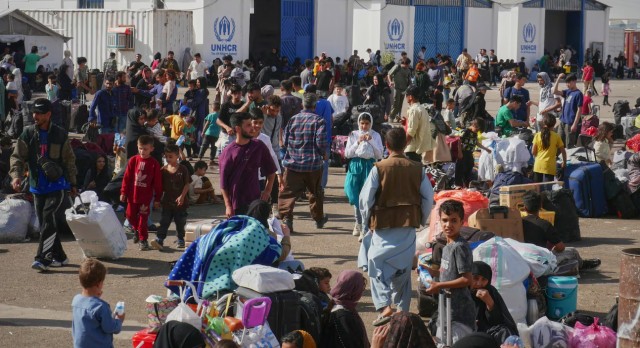
Afghan refugees who returned after fleeing Iran to escape deportation and conflict gather at a UNHCR facility near the Islam Qala crossing in western Herat province, Afghanistan, on Friday, June 20, 2025. (AP Photo)
The humanitarian crisis in Afghanistan is on the brink of worsening, as the Red Cross warns that another one million Afghans could be forced to return from Iran by the end of the year.
More than 1.2 million people have already been deported from Iran since January, according to UN data. The pace of these returns has surged, especially following recent military escalations between Iran and Israel. Now, aid organizations say they are struggling to keep up.
Sami Fakhouri, head of the Afghanistan delegation at the International Federation of Red Cross and Red Crescent Societies (IFRC), painted a troubling picture from the ground.
Speaking to reporters in Geneva, he described watching busloads of people being dropped at the Islam Qala border crossing in Herat province.
“Most of them had no choice,” Fakhouri said. “They were put on buses and driven out. Many haven’t been in Afghanistan for years and now have nowhere to go.”
Aid Efforts Are Stretched Thin
The return of so many Afghans—many of whom have lived in Iran for decades—is placing immense pressure on an already fragile system. Afghanistan is battling an ongoing humanitarian crisis, worsened by economic collapse and political instability following the Taliban takeover in 2021.
Now, the strain is growing, as tens of thousands are returning from Iran daily—often without belongings, shelter, or a support network. The situation is compounded by the fact that hundreds of thousands have also been forced to return from Pakistan in recent months.
To address the mounting need, IFRC launched an emergency appeal for 25 million Swiss francs (roughly US$31.4 million) to assist returnees at the border and in temporary shelters. But so far, only 10% of the funding has been secured.
Fakhouri warned that without more financial support, it will become impossible to meet even the most basic needs of those arriving daily. Food, water, shelter, and medical assistance are already stretched dangerously thin.
Family Separation and Trauma
Babar Baloch, a spokesperson for the UN refugee agency (UNHCR), highlighted another urgent concern: family separations.
“On July 4 alone, over 50,000 people crossed the border back into Afghanistan from Iran,” he said. “Many were separated from loved ones. Children, in particular, are suffering trauma.”
He stressed that these forced returns are leaving deep emotional wounds.
“The psychological scars will stay with these people,” Baloch warned.
Looking Ahead: An Uncertain Future
As aid organizations scramble to offer help, the future for these returnees remains uncertain. Most have returned to a country they barely recognize, with no homes, no jobs, and no support. For many, especially women and children, the journey ahead is bleak.
The Red Cross and UN are urging the international community to step up. More funding, diplomatic pressure, and humanitarian support are urgently needed to prevent a worsening catastrophe.
For now, Afghanistan braces for another wave of returnees—and the world watches