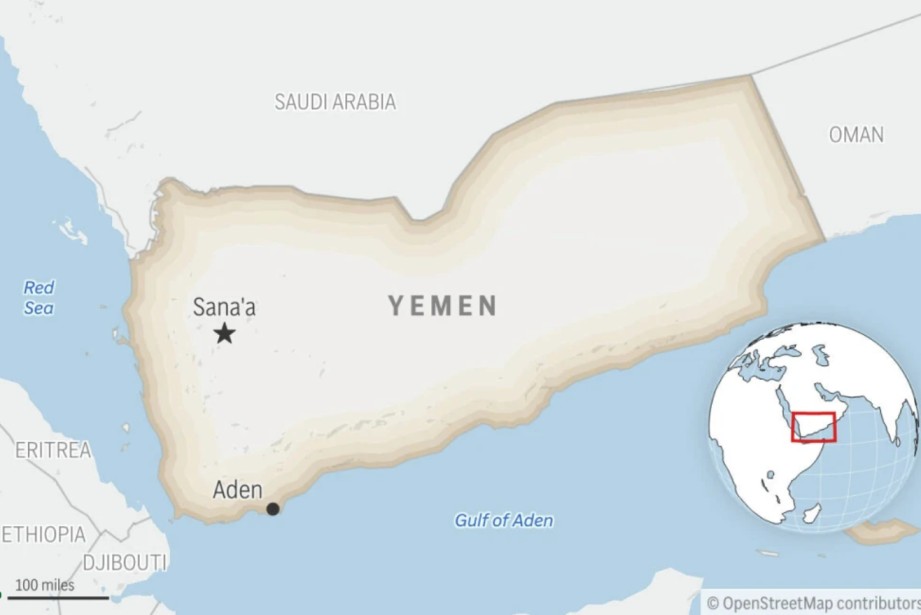
This is a locator map for Yemen with its capital, Sanaa.
A major internet disruption has hit several nations across Asia, Africa, and the Middle East. Experts believe commercial shipping activity in the Red Sea likely damaged multiple undersea cables, exposing the vulnerability of global digital infrastructure.
How the Internet Blackout Began
The outage began over the weekend when authorities noticed severe connectivity issues. Investigations revealed damage to submarine cables running through the Red Sea, a vital corridor for international data. Initially, three cables were reported damaged — South East Asia–Middle East–Western Europe 4 (SEA-ME-WE 4), India-Middle East-Western Europe (IMEWE), and FALCON GCX. By Tuesday, the Europe India Gateway cable was also confirmed affected.
Why the Red Sea Matters for Internet Cables
The Red Sea’s Bab el-Mandeb Strait, which links East Africa to the Arabian Peninsula, is one of the busiest marine passages in the world. According to the International Cable Protection Committee, 15 submarine cables pass through this narrow stretch. These cables serve as critical lifelines for internet connectivity between Asia, the Middle East, and Europe.
Commercial Shipping Suspected as the Cause
Experts strongly suspect that a ship’s anchor dragged across the seabed and sliced through the cables.
“Damage to submarine cables from dragged anchors account for about 30% of incidents every year,” said John Wrottesley, operations manager at the International Cable Protection Committee. He added that such incidents typically lead to around 60 faults annually.
Doug Madory, director of internet analysis at Kentik, also confirmed that the working assumption was an anchor drag caused by a commercial vessel. Shallow waters in parts of the Red Sea make the cables more vulnerable to such accidents.
Internet Users Face Slow Speeds and Lag
Undersea cables form the backbone of the internet, alongside satellites and land cables. Service providers usually reroute traffic through alternative lines, preventing complete blackouts. However, rerouting can slow down speeds and cause high latency for users. At least 10 countries, including India, Pakistan, and the United Arab Emirates, have reported being affected by the disruption.
Security Concerns in the Red Sea
This is not the first time cables in the region have faced threats. In early 2024, Yemen’s internationally recognized government warned that Houthi rebels planned to target undersea cables amid rising tensions from the Israel-Hamas conflict. Later, multiple cables were cut, possibly due to a damaged ship attacked during the unrest. Houthis, however, denied responsibility for those incidents.
A Fragile Digital Lifeline
The repeated cable cuts highlight the fragile nature of global connectivity. Each disruption serves as a reminder that much of the world’s internet traffic flows through narrow maritime chokepoints, where accidents or deliberate attacks can have widespread consequences.
For now, repair operations are expected, but restoring full capacity may take weeks. Meanwhile, millions of users across Asia, Africa, and the Middle East continue to face slower internet speeds, underscoring the urgent need for better cable protection in critical zones like the Red Sea.