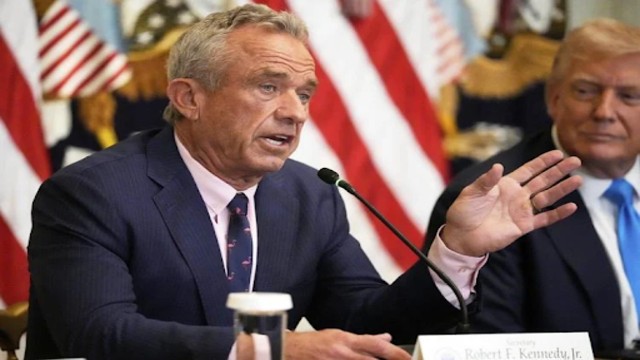
Health and Human Services Secretary Robert F. Kennedy Jr. speaks as President Donald Trump listens at an event to promote his proposal to improve Americans' access to their medical records in the East Room of the White House, Wednesday, July 30, 2025, in Washington. (AP Photo)
The U.S. government is pulling the plug on over $500 million in vaccine development projects, following an unexpected decision by Health and Human Services Secretary Robert F. Kennedy Jr. On Tuesday, Kennedy announced the cancellation of 22 research efforts focused on mRNA technology — the same platform behind COVID-19 and flu vaccines developed by pharmaceutical giants like Pfizer and Moderna.
These projects, once aimed at protecting Americans from emerging respiratory threats such as COVID-19, influenza, and even bird flu (H5N1), are now shelved. The decision underscores a major shift in the country’s public health strategy, led by a longtime vaccine critic now in a key leadership role.
Kennedy Doubles Down on Vaccine Skepticism
Kennedy, who has repeatedly questioned vaccine safety, released a video on social media outlining the reasoning behind the move. He criticized mRNA platforms, calling them “troubled” and “fragile” in the face of viral mutations. Instead, he proposed an alternative approach: investing in whole-virus vaccines and newer technologies that, according to him, offer more reliable protection.
“To replace the troubled mRNA programs, we’re prioritizing the development of safer, broader vaccine strategies,” Kennedy said. He also hinted at work being done on a “universal vaccine” designed to mimic natural immunity and target both flu and coronaviruses.
Expert Backlash: “A Dangerous Decision”
Public health experts are raising red flags. Dr. Mike Osterholm, a renowned infectious disease specialist from the University of Minnesota, called Kennedy’s move the most “dangerous decision in public health” he’s seen in 50 years.
Osterholm, along with other health authorities, emphasized that mRNA technology was instrumental in containing the COVID-19 pandemic during its early stages. The speed and flexibility of mRNA platforms, they say, could be critical in responding to the next pandemic — one that might not wait for traditional vaccine timelines.
Dr. Paul Offit of Children’s Hospital of Philadelphia agreed. He warned that pulling back now, especially with concerns about bird flu on the rise, could be short-sighted. “It’s certainly saved millions of lives,” he said, referring to existing mRNA-based vaccines.
mRNA’s Broader Medical Promise
Beyond infectious diseases, mRNA is also being explored for treating cancer. Earlier this year, tech billionaire Larry Ellison spoke at the White House, applauding its potential in oncology. Scientists worldwide are exploring how this genetic messaging system can train the body to fight tumors more precisely and efficiently.
In contrast to traditional vaccines — which require growing viruses in eggs or cells — mRNA vaccines work by sending a snippet of genetic code that instructs the body to make a specific protein. That protein triggers an immune response, teaching the body how to fight the real virus if it ever arrives.
Despite the cancellation of vaccine-related contracts, the Department of Health and Human Services clarified in a statement that “other uses of mRNA technology within the department are not impacted.”
Political Overtones and a New Direction
Kennedy’s decision is not just scientific — it’s political. Since taking charge, he has dismissed the advisory panel that made vaccine recommendations and declined to fully endorse COVID-19 shots even amid measles outbreaks.
At a press conference later on Tuesday in Anchorage, Alaska, Kennedy stood firm. Flanked by two Republican U.S. Senators, he confirmed that work is underway on alternative vaccines. “We believe it’s going to be effective — against not only coronaviruses, but also flu,” he said of the new “natural immunity”-based option in development.
A Pivotal Moment for U.S. Health Policy
As the nation pivots away from mRNA vaccine investment, public health experts are watching closely. While Kennedy insists he supports “safe, effective vaccines for every American who wants them,” many worry the decision could undermine preparedness in the face of future outbreaks.
Only time will tell whether this gamble reshapes vaccine development — or sets the country back in its fight against evolving viruses.