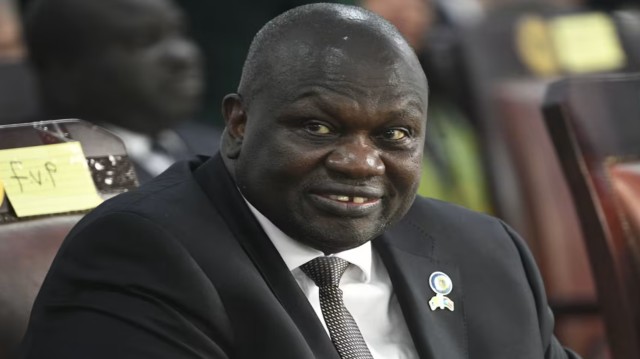
South Sudan's Vice President Riek Machar attends a meeting of Pope Francis with authorities, leaders of civil society and the diplomatic corps, in the garden of the Presidential Palace in Juba, on February 3, 2023.
South Sudan has been plunged into fresh political turmoil after Vice President Riek Machar was charged with treason, murder, and crimes against humanity. The charges are linked to deadly militia attacks in March, sparking fears of renewed conflict in the fragile nation.
President Suspends Machar After Charges
Just hours after the announcement, President Salva Kiir suspended Machar from his position as First Vice President. The decree, broadcast on state radio, offered no additional explanation. This move has intensified the already fragile relationship between Kiir and Machar, once bitter rivals during South Sudan’s devastating civil war.
Petroleum Minister Also Removed
Alongside Machar, Petroleum Minister Puot Kang Chol was also suspended. He faces similar charges, deepening the crisis within the government. Their removal signals a widening rift within the leadership of the young nation.
Allegations Tied to White Army Militia
Justice Minister Joseph Geng revealed that the charges stem from violent clashes in Nasir, a northeastern town attacked by the ethnic White Army militia in March. Geng claimed that evidence shows the militia acted under the influence of leaders from the Sudan People’s Liberation Movement/Army-in Opposition (SPLM/A-iO), including Machar.
“Evidence further reveals that the White Army operated under the command and influence of certain SPLM/A-iO leaders, including Dr. Riek Machar Teny,” Geng said.
Calls for Machar’s Release
Since March, Machar has been under house arrest over his alleged role in the Nasir violence. International powers, including regional mediators, have consistently urged South Sudan to release him, warning that prolonged detention could destabilize the country and trigger renewed fighting.
Despite these appeals, the government insists the matter is now “sub judice” and will be handled strictly through legal channels.
Civil War Shadows Resurface
The suspension of Machar raises memories of South Sudan’s bloody civil war from 2013 to 2018, in which nearly 400,000 people were killed. The conflict was rooted in a bitter power struggle between Kiir and Machar. A peace deal brought them together in a unity government, but mistrust and sporadic violence have never fully disappeared.
Observers fear that the latest developments could shatter the fragile peace and push South Sudan back toward conflict.
More Leaders Indicted
Besides Machar and Chol, 20 others were also indicted. According to Justice Minister Geng, 13 remain at large. The widespread charges suggest the government is pursuing a sweeping crackdown linked to the Nasir incident.
Activists Demand a Fair Trial
South Sudanese civil society leaders have voiced concern over the credibility of the judicial process. Edmund Yakani, executive director of the Community Empowerment for Progress Organization, urged transparency and fairness.
He warned against turning the trial into a political show, stating:
“We hope the court will be a competent court of law, not a kangaroo court of law.”
Unity Government in Crisis
The collapse of trust between Kiir and Machar poses a severe threat to the fragile unity government. Their uneasy alliance was the cornerstone of South Sudan’s peace deal, but the latest feud may undo years of hard-won progress.
As the legal process unfolds, questions remain over whether South Sudan’s leadership can contain the fallout—or if the nation will slide back into the chaos of war.