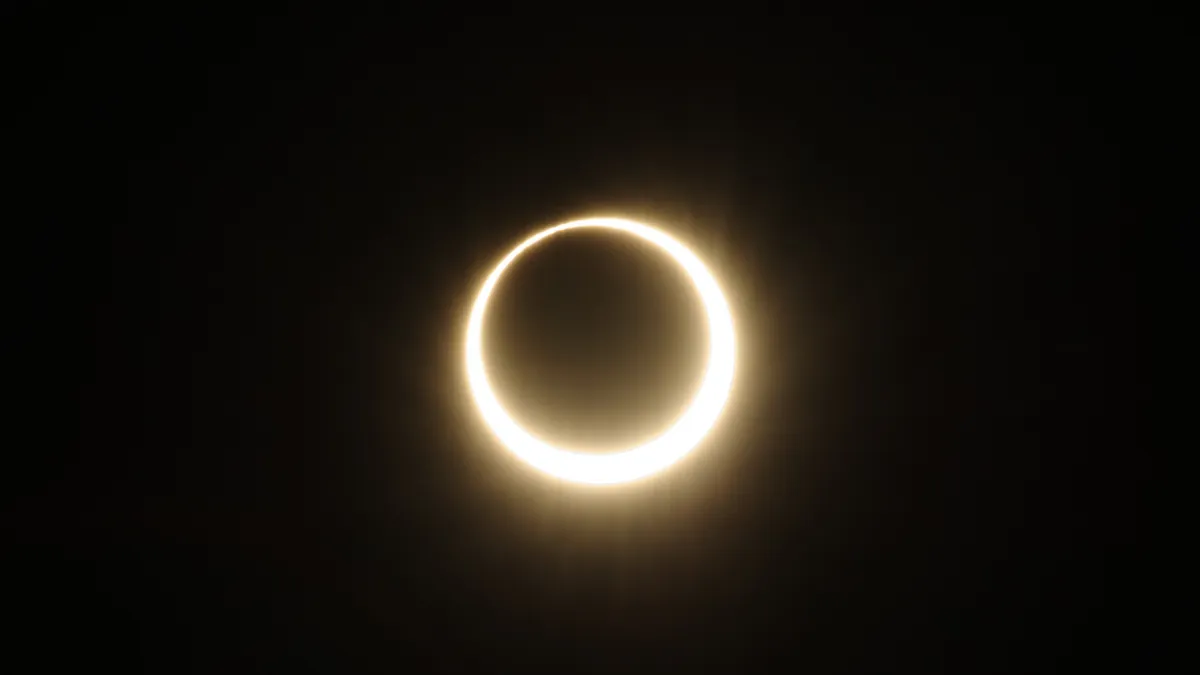
The glowing “ring of fire” appeared during an annular solar eclipse seen from Oregon on October 14, 2023. Getty Images
Skywatchers around the world will mark their calendars for February 17, 2026, when the first solar eclipse of the year takes place. This event will appear as an annular solar eclipse, a striking phenomenon often called a “ring of fire” eclipse.
An annular eclipse happens when the moon passes in front of the sun but does not fully block it. Instead of total darkness, a bright circle of sunlight remains visible around the moon’s edges.
Why it’s called a ‘ring of fire’
During this type of eclipse, the moon appears slightly smaller than the sun. As it moves across the sun’s face, it leaves a thin, glowing ring of light. This creates the dramatic “ring of fire” effect that gives the eclipse its popular name.
The visual contrast between the dark moon and the bright ring makes annular eclipses especially eye-catching, even though they do not bring the same darkness as a total solar eclipse.
Where the full effect will be visible
Only a small number of people will see the full ring of fire in person. The path where the annular phase appears will cross a remote area of Antarctica. In that region, the moon will cover up to 96 per cent of the sun for just over two minutes.
Because of the location, very few observers will witness the full annular eclipse directly. Most of the world will not see the complete ring effect.
Partial eclipse visible in other regions
While the full annular view will remain limited, many people will still catch a partial solar eclipse. During a partial eclipse, the moon covers only part of the sun.
Observers in Antarctica, parts of southern Africa, and the southern tip of South America will see the sun partially blocked. The amount of coverage will vary by location, with some areas seeing a noticeable bite taken out of the sun.
What to expect during the event
Unlike a total solar eclipse, daylight will not fully fade during this event. The sky may dim slightly in areas where the partial eclipse appears, but daytime conditions will remain.
The eclipse will unfold gradually as the moon moves across the sun, reaches its peak coverage, and then slides away. The entire process will take several hours from start to finish, depending on location.
Eye safety remains essential
Anyone planning to observe the eclipse must protect their eyes. Looking directly at the sun without proper protection can cause serious eye damage. Special solar viewing glasses or approved filters should always be used when watching a solar eclipse.
Even during partial coverage, the sun’s rays remain strong and dangerous to view without protection.
A rare moment in the sky
Although few people will witness the full ring of fire, the February 17 eclipse remains an important moment for astronomy fans. It offers a reminder of the precise movement of the sun, moon, and Earth, and it sets the stage for future eclipses later in the year.