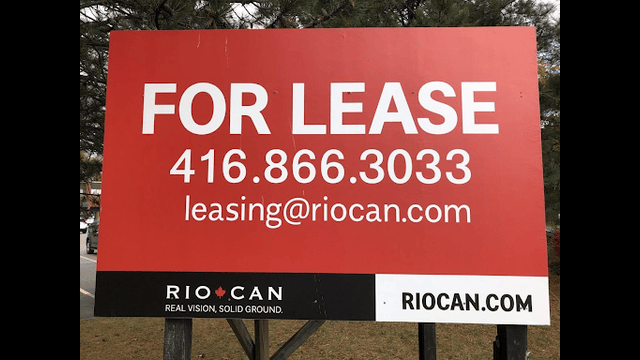
A RioCan sign stands at a shopping plaza in Mississauga, Ontario. RioCan ranks among Canada’s biggest real estate investment trusts. (Photo: Richard Buchan / The Canadian Press)
RioCan Real Estate Investment Trust has decided to stop funding five properties from its joint venture with the now-closed Hudson’s Bay, moving to distance itself from the troubled investment.
Chief financial officer Dennis Blasutti confirmed during the company’s second-quarter earnings call that RioCan will no longer provide financial backing for these locations. “We will not put any more money into these assets, in any form,” he said.
Why RioCan Is Walking Away
The joint venture once managed 12 Hudson’s Bay properties. However, all stores shut down in early June after liquidation sales. Last quarter, RioCan reduced the value of its stake in the partnership by $208.8 million. By the end of June, the net worth of these holdings stood at $40.2 million—just 0.5 per cent of RioCan’s total equity.
Chief executive Jonathan Gitlin said the decision to withdraw came down to practicality. Renovating the properties and managing existing debt would require major investment without promising returns. “We’ve taken the pragmatic route to walk away financially,” Gitlin explained.
Which Locations Are Affected
The five properties RioCan will no longer support include:
- Square One Shopping Centre in Mississauga, Ontario
- Scarborough Town Centre in Toronto
- Hudson’s Bay’s former downtown Calgary store
- Carrefour Laval in Quebec
- Promenades St-Bruno in Quebec
Gitlin added that the company is still assessing the fate of the remaining seven properties. Some may be released, others sold, while a few might share the same fate as the five already cut off.
Focus Shifts to Stronger Returns
RioCan is clear about one thing—it won’t put capital into assets that don’t deliver a solid, risk-adjusted return. While it moves away from the Hudson’s Bay properties, its broader real estate portfolio continues to perform well.
Lease rates for new agreements and renewals are up 20.6 per cent compared to older contracts, with new leases alone showing a 51.5 per cent increase. Retail occupancy stands at 98.2 per cent, nearly unchanged from last year’s 98.3 per cent.
“We’re confident we can fill any vacant space with higher-quality, higher-paying tenants,” Gitlin said, despite slower economic growth.
Financial Performance Shows Growth
For the quarter ending June 30, RioCan reported net income of $145.6 million, up from $122.3 million in the same period last year. Earnings per unit rose to 49 cents from 41 cents. Revenue climbed to $361.7 million, compared to $292.2 million last year.
RioCan has also scaled back on large construction projects, completing major mixed-use developments and avoiding new big builds. Instead, it plans smaller infill retail projects, which cost less and deliver quicker returns. “We now have enough tenant demand to justify the rents needed for these projects,” Gitlin noted.