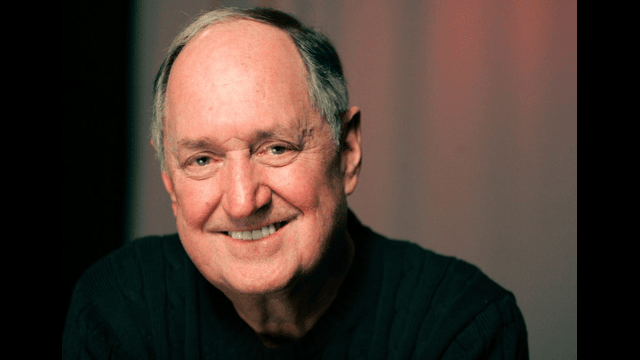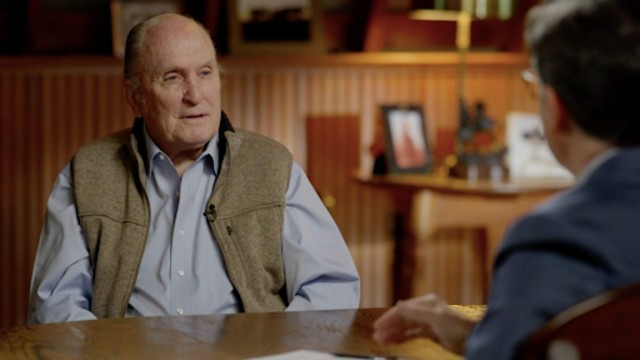
A Late Show with Stephen Colbert and guest Robert Duvall during Thursdays June 24, 2021 show.
The screen never needed Robert Duvall to dominate it — he simply inhabited it. With a glance, a pause, or a measured line, he could steady the chaos of an entire scene. The Oscar-winning actor, whose career stretched across more than six decades and produced some of cinema’s most finely etched characters, has died peacefully at his home in Middleburg, Virginia. He was 95.
To audiences, he was the calm strategist in The Godfather, the battle-hardened officer in Apocalypse Now, and the broken country singer seeking redemption in Tender Mercies. To fellow actors, he was the performer who arrived completely prepared, needed only a handful of takes, and left behind a standard few could match.
A Career Built on Precision, Not Stardom
Duvall never fit the conventional mold of a leading man, yet his presence became indispensable to American cinema. Bald, wiry, and watchful, he specialized in men who revealed their depth slowly. His performances were rarely loud, but they lingered.
His breakthrough came early with the role of the reclusive Boo Radley in To Kill a Mockingbird — a brief appearance that announced a remarkable new talent. A decade later, Francis Ford Coppola cast him as Tom Hagen, the adopted consigliere of the Corleone family. In a film crowded with towering personalities, Duvall’s restraint became its moral center.
Critics often noted that while others delivered the fireworks, Duvall supplied the structure — the listener, the adviser, the man who made power look procedural.
The Role That Won Him the Oscar
Recognition at the highest level arrived with Tender Mercies, where he played a washed-up country singer searching for dignity after failure. The performance earned him the Academy Award for Best Actor and confirmed what many in the industry already believed — that no one portrayed wounded masculinity with more honesty.
He collected seven Oscar nominations across his career, along with multiple Golden Globes, and later received the National Medal of Arts. Even in his eighties, he continued to deliver work that drew critical acclaim, including his nominated turn in The Judge.
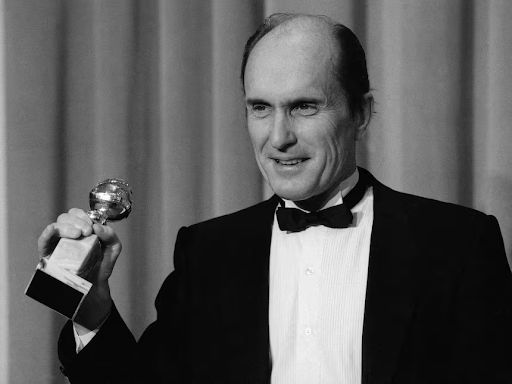
Duvall holds the Golden Globe award he won for best actor in a dramatic motion picture for his role in Tender Mercies in January 1984. (The Associated Press)
Volcanic Energy Beneath the Calm
For all his controlled performances, Duvall carried an intense working method. Co-stars learned to leave him alone before difficult scenes. Directors admired his efficiency. Michael Caine once described the charged silence that surrounded him before the camera rolled.
That focus could erupt into a famously sharp temper if he felt the work was being compromised. Yet the same intensity drove his meticulous research. For The Apostle, a film he wrote, directed, produced, and largely financed himself, he spent years visiting churches and shaping the script.
From Military Childhood to Method Actor
Born in San Diego and raised in naval towns, Duvall absorbed the rhythms of American speech and the psychology of military life — details he would later channel into unforgettable roles. Acting was initially suggested as a practical way to stay in college and avoid the draft. Instead, it became his calling.
After serving in the Army, he studied in New York alongside future stars Gene Hackman and Dustin Hoffman, taking television roles while refining his craft on stage.
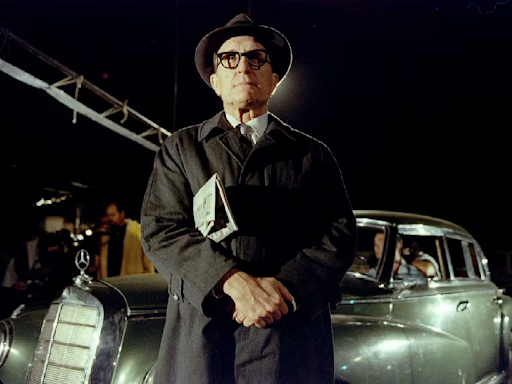
Duvall is seen in character as he portrays the Nazi official Adolf Eichmann in the 1996 film The Man Who Captured Eichmann. (Reuters)
Always Searching for Something New
Between major studio projects, Duvall pursued deeply personal films — documentaries, small character studies, and a passion project inspired by Argentine tango. He resisted the idea of slowing down, once remarking that staying “hungry” was essential to longevity.
That hunger kept him working into his later years, long after most of his contemporaries had stepped away.
An Actor Who Made Others Better
Perhaps his greatest legacy is not a single role but a way of performing. Duvall elevated ensembles. He made stars look sharper, scenes feel truer, and stories more grounded. He was the rare actor equally at home in supporting parts and leading roles, never treating either as lesser.
In an industry that often rewards spectacle, Robert Duvall built a monumental career out of nuance.