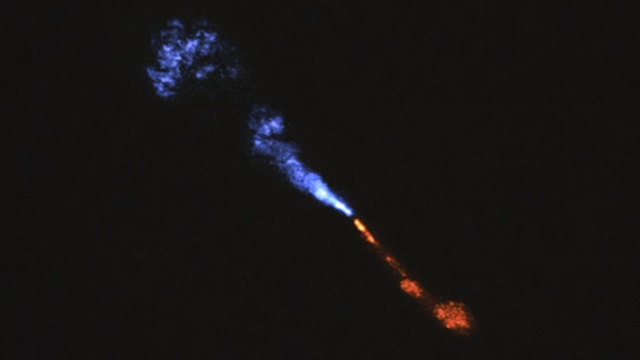
A photo released by the European Southern Observatory on Tuesday, July 15, 2025, shows streams of silicon monoxide gas being pushed out from the young star known as HOPS-315. The image was captured using the ALMA telescope by Melissa McClure and her team. AP Photo
Astronomers have spotted the earliest signs of rocky planets forming around a newborn star. This rare find gives us a better idea of how planets like Earth may have formed billions of years ago.
The discovery was made by an international team of researchers led by Melissa McClure from the Netherlands. She said, “We’ve captured a direct glimpse of the hot region where rocky planets like Earth are born around young protostars.” This is the first time scientists have seen this process happening so clearly.
How They Found It
The team used two powerful tools to make this discovery — one in space and one on Earth. They combined observations from a large telescope in Chile with data from a space telescope. These helped them study a very young star called HOPS-315. This star is similar to our sun, but it is much younger — only about 100,000 to 200,000 years old. It’s located about 1,370 light-years away from Earth.
What They Saw in the Gas Disk
Around the baby star, there’s a thick ring of gas and dust. This ring is where planets can start to form. Thanks to the way this ring is tilted toward Earth, scientists were able to see deep inside it. What they found was incredible — tiny solid particles beginning to take shape. These are the building blocks of rocky planets.
They also found silicon monoxide gas and minerals called crystalline silicates. These materials were likely the first solids to form in our own solar system more than 4.5 billion years ago. These minerals were found in the same part of the disk where our asteroid belt is now, between Mars and Jupiter.
Why This Matters
Until now, scientists had never clearly seen these early steps of planet-making around other stars. McClure explained that this discovery shows the early planet-forming process could be common in the universe. It’s not just something that happened in our solar system.
Fred Ciesla, a scientist not involved in the study, said, “This is one of the things we’ve been waiting for.” He added that this discovery opens up exciting new research opportunities.
What Happens Next
It’s too soon to know how many planets might form around HOPS-315. But the gas disk around it is large, like the one that formed our solar system. That means it could possibly form many planets — maybe even eight — over the next million years or so.
Merel van ’t Hoff, one of the study’s authors, said she wants to find more stars like this. She hopes that by studying more newborn stars, scientists can learn what makes Earth-like planets special — or if they’re more common than we think.
Looking Ahead
The discovery could help answer a big question: Is Earth unique, or are there many planets like ours in the universe? Scientists will now search for more baby stars and track how they grow, hoping to unlock more secrets about how planets begin.