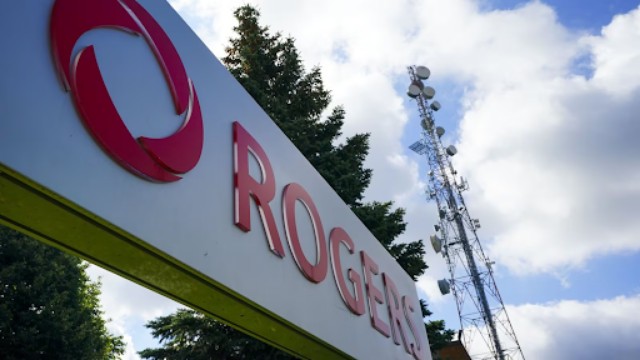
Rogers Communications has posted a drop in its second-quarter earnings compared to last year. The dip is mainly due to increased spending on restructuring, acquisitions, and other related expenses. The company's logo was recently seen in Ottawa on July 12, 2022. THE CANADIAN PRESS/Sean Kilpatrick
Rogers Communications is on a mission to unlock new value from its growing sports empire after officially becoming the majority owner of Maple Leaf Sports & Entertainment (MLSE). The Toronto-based telecom giant is now focusing on reducing costs and boosting income through smarter use of its sports and media properties.
Earlier this month, Rogers completed a $4.7-billion purchase of BCE Inc.’s 37.5% stake in MLSE. That move gave Rogers majority control over some of Canada’s biggest sports franchises, including the Toronto Maple Leafs (NHL), Raptors (NBA), Argonauts (CFL), Toronto FC (MLS), and Marlies (AHL). Rogers also owns the Toronto Blue Jays baseball team and their home, the Rogers Centre.
Making Sports Work Smarter
Company CEO Tony Staffieri said they believe the market undervalues their media and sports investments. Now that Rogers fully controls MLSE, it hopes to “unlock” this hidden value and turn it into stronger returns for shareholders.
“Our job is twofold,” said Staffieri during a recent earnings call. “First, we must build a stronger financial foundation. Second, we must show our shareholders the true worth of our sports assets. We’re reviewing many options—and the good news is, we have some great ones.”
While it’s too early for specific announcements, Staffieri hinted that clearer plans will emerge before the end of 2026. He referred to the successful 2023 merger with Shaw Communications as proof that Rogers knows how to streamline and scale effectively.
A Bigger Picture: Will Blue Jays Join the MLSE Lineup?
Some market experts have suggested Rogers might merge the Blue Jays and Rogers Centre with MLSE’s assets, like the Scotiabank Arena. When asked about this possibility, Rogers’ Chief Financial Officer Glenn Brandt didn’t deny the idea. He noted that combining teams and venues under one umbrella could help cut costs and increase revenue.
Boosted Outlook for 2025
Rogers also updated its 2025 financial forecast, expecting service revenue to rise between 3% and 5%, higher than the earlier estimate of up to 3%. This change reflects the expected impact from MLSE’s operations.
Still, the company’s second-quarter earnings took a dip. Rogers posted a $148 million profit—or 29 cents per share—down sharply from $394 million (73 cents per share) in the same period last year. The drop was mostly due to higher restructuring and acquisition costs, which hit $238 million this quarter.
Total revenue, however, was up slightly to $5.22 billion, compared to $5.09 billion the year before. Growth came from wireless equipment sales (up 13%) and stronger media income (up 10%), especially due to NHL playoff coverage on Sportsnet and the addition of Warner Bros. Discovery channels.
Mobile Growth Slows, but Remains Stable
The company added 61,000 mobile subscribers this quarter, including 35,000 postpaid customers. That’s a drop from 112,000 postpaid adds in the same period last year. Prepaid customer growth also slowed to 26,000 from 50,000.
Still, the number of people cancelling mobile service went down slightly. Rogers also saw a 1% rise in cable revenue and modest growth in internet subscriptions (26,000 new users).
Average monthly revenue per mobile user dipped to $55.45, down from $57.24 a year ago. However, analysts said the overall performance met expectations. Maher Yaghi from Scotiabank noted that despite pricing pressure, the outlook appears solid thanks to recent price hikes and market stabilization.