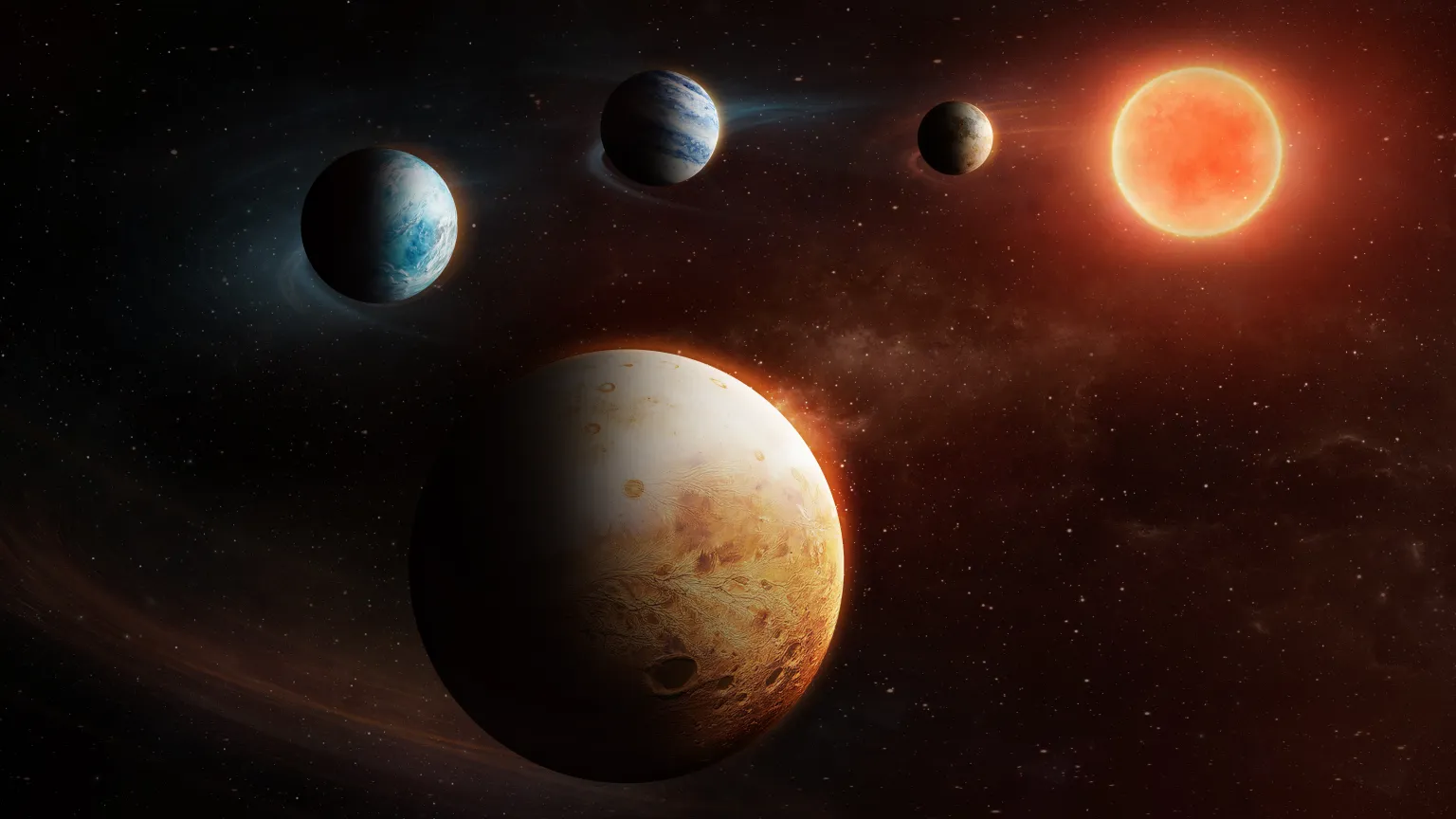
Artist’s illustration showing the possible appearance of this unusual planetary system. Credit: ESA
Astronomers have discovered a distant rocky planet orbiting far from its star in a way that challenges long-held ideas about how planetary systems form.
The unusual system surrounds a faint red dwarf star known as LHS 1903. Four planets circle the star. What surprised researchers is the outermost world. Instead of being a large gas planet, as scientists would expect, it is small and rocky.
An Unexpected Arrangement
In our own solar system, rocky planets such as Mercury, Venus, Earth and Mars orbit close to the Sun. Massive gas giants like Jupiter and Saturn sit much farther out. This pattern appears common throughout the Milky Way.
Scientists therefore expected the most distant planet in the LHS 1903 system to be made mainly of gas.
Instead, the fourth planet turned out to be rocky. That finding puzzled researchers.
“This strange disorder makes it a unique inside-out system,” explained first author Dr Thomas Wilson, Assistant Professor in the Department of Physics, University of Warwick. “Rocky planets don’t usually form far away from their home star, on the outside of the gaseous worlds.”
Searching for Answers
Dr Wilson and his team examined several possible explanations. They ruled out the idea that planets switched positions over time. They also dismissed the possibility that the outer planet once had a thick atmosphere but lost it during a violent collision.
After reviewing the evidence, the team believes the planets may not have formed at the same time. Instead, they suggest the system developed gradually, one planet after another, through what researchers call inside-out planet formation.
Under this scenario, inner planets form first. As time passes, the gas and dust needed to build larger gas planets begin to thin out.
“By the time this final outer planet formed, the system may have already run out of gas, which is considered vital for planet formation,” Dr Wilson added. “Yet here is a small, rocky world, defying expectations. It seems that we have found first evidence for a planet that formed in a gas-depleted environment.”
A New Clue in Planetary Science
The discovery raises new questions about how planets grow and evolve. If this rocky world formed without much gas available, similar systems could exist elsewhere in the galaxy.
Researchers caution that the planet may still represent a rare case. However, it could also point to a broader pattern scientists have yet to fully understand.
“Much about how planets form and evolve is still a mystery,” said Maximilian Günther, Cheops project scientist at ESA. “Finding clues like this one for solving this puzzle is precisely what CHEOPS set out to do.”
Looking Ahead
The finding adds to the growing list of unusual planetary systems discovered in recent years. Each new observation helps scientists refine their understanding of how stars and planets take shape.
For now, the rocky outer planet around LHS 1903 stands as an unexpected exception to a rule that astronomers once considered nearly universal. Further studies may reveal whether it is truly unique or simply the first of many similar worlds waiting to be discovered.
The research appears in the journal Science.