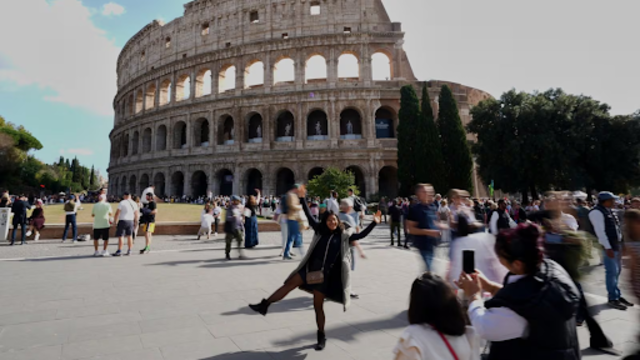
A view of Rome’s historic Colosseum captured on Friday, October 24, 2025. AP
Rome’s new Colosseum director wants to clear the air — there won’t be any raves or wild parties inside the ancient amphitheatre. Simone Quilici, who recently became director of the Archaeological Park of the Colosseum, said he plans to bring music and cultural events back to the historic landmark, but under strict respect for its history and meaning.
Social media buzzed earlier this month after an Italian interview suggested concerts could return to the 2,000-year-old arena. Soon, rumours of “massive raves” spread online, complete with AI images of laser lights blasting into the Roman sky. Quilici said the reports twisted his words.
“I joked about rock in moderation,” he explained. “The idea was gentle music — calm artists who attract calm crowds. What I said got completely flipped.”
A Sacred Space, Not a Party Venue
The Colosseum, once the stage for ancient gladiators, now holds deep symbolic and religious importance. It serves as the site for the Via Crucis Easter procession, often led by the Pope himself. Quilici said any performance inside the amphitheatre must respect that heritage.
“The music must be controlled,” he said. “The Colosseum is part of Rome’s identity. It’s a sacred place.”
Concerts, when approved, could include acoustic, classical, or jazz performances. Quilici even mentioned Sting as an ideal artist for such an event. Poetry readings, dance shows, and theatrical performances are also on the table once the site’s small platform is expanded.
Gladiators, Not Centurions
The director also hopes to introduce historically accurate gladiatorial reenactments based on academic research. These, he said, would be nothing like the fake centurions who pose with tourists outside and demand payment.
“There are experts who know every detail of ancient life,” Quilici said. “Their presentations bring history to life with scientific accuracy.”
However, visitors will have to wait — Quilici said the first performances won’t happen for at least two years.
The Colosseum has hosted only a few concerts in modern times, including performances by Ray Charles, Paul McCartney, and Andrea Bocelli. Each was a special event with limited attendance.
“Tourism is often commercial,” Quilici noted. “But if we blend culture and art, this place can offer more than sightseeing. It can inspire.”
Beyond the Colosseum
Quilici also wants to spread tourist attention beyond the Colosseum’s walls. Nearly nine million people visited the amphitheatre last year, while fewer explored nearby treasures like the Roman Forum and Palatine Hill — both included in the same ticket.
“Many tourists come for just the Colosseum and miss the rest,” he said. “We want to help them discover all of ancient Rome.”
He aims to connect the city’s key archaeological areas, including the Circus Maximus and the Appian Way, by creating new access routes and pedestrian zones.
“It’s about better management, not massive spending,” Quilici said. “Sometimes, it just takes the courage to make simple choices — like limiting traffic — to bring life back to Rome’s heart.”