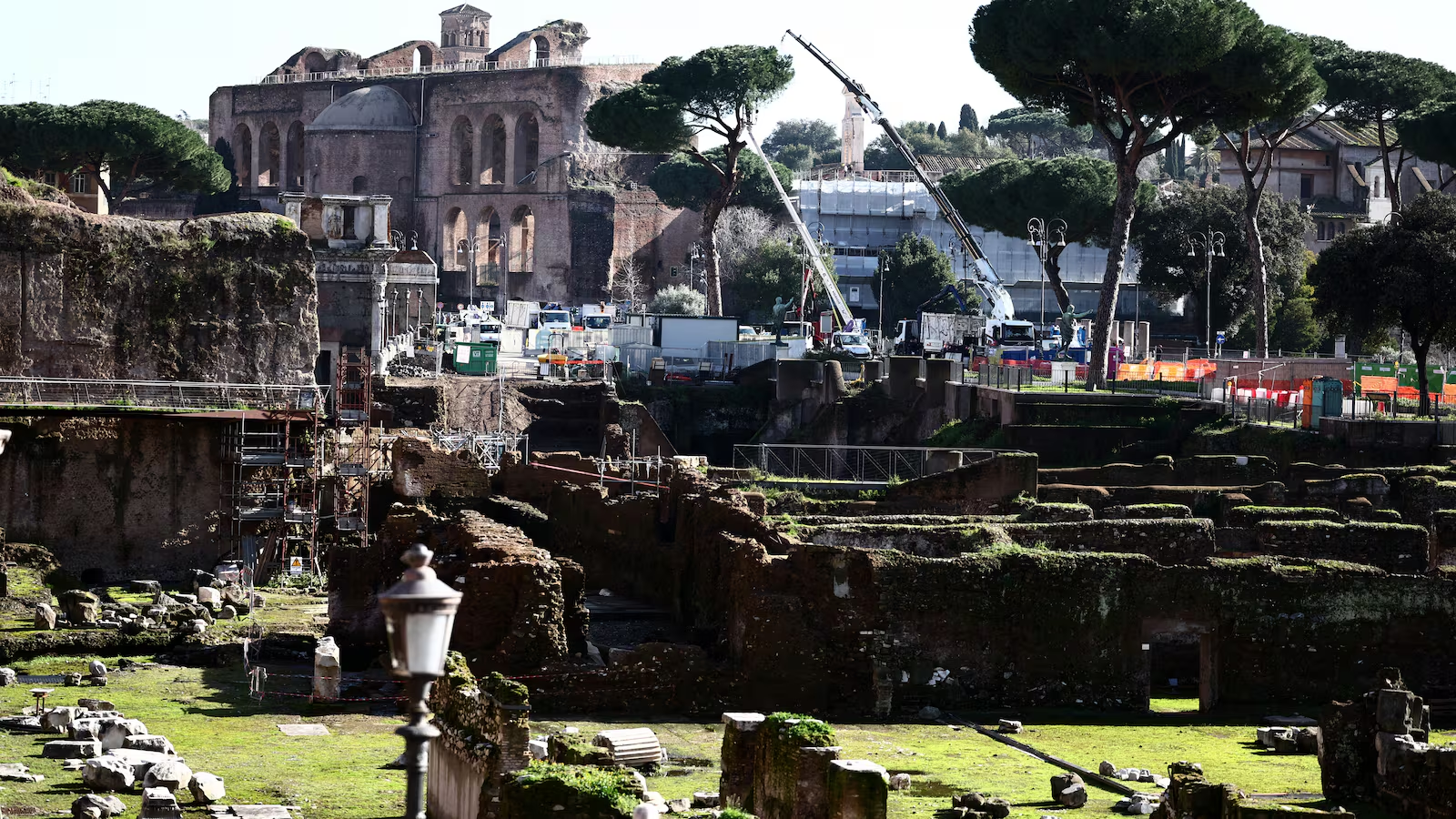
Workers cut a pine tree along the Imperial Forum avenue in Rome on Feb. 13, 2026.
Rome has begun removing several aging umbrella pines along the historic avenue near the Roman Forum.
Officials acted after safety inspections revealed multiple trees could collapse without warning.
The decision follows recent incidents that raised concern among residents, tourists, and heritage authorities.
The ceremonial road connects the Colosseum to Piazza Venezia and attracts heavy daily crowds.
Because the route is one of Rome’s most photographed locations, public safety became an urgent priority.
Sudden Tree Falls Trigger Emergency Action
Since early January, three large umbrella pines have already fallen along the avenue.
The incidents caused minor injuries to three pedestrians and alarmed city authorities.
Although injuries were limited, the events exposed growing risks from the aging trees.
Engineers quickly ordered detailed stability tests across the entire tree-lined stretch.
These inspections focused first on the area closest to the Roman Forum’s busiest pedestrian zones.
Authorities wanted immediate answers before reopening the scenic road fully.
Tests Reveal Multiple Unstable Pines
Initial technical checks examined the first group of 36 historic trees.
Results showed that 12 trees were structurally unstable and required urgent removal.
Meanwhile, 24 others appeared stable or needed additional monitoring and analysis.
Overall, the historic avenue contains 54 umbrella pines.
Many of these trees are believed to be nearly 120 years old.
Their age, combined with environmental stress, has weakened root systems and internal structure.
Climate Pressure Weakening Rome’s Iconic Trees
Umbrella pines have long shaped Rome’s skyline and summer landscape.
They offer wide shade canopies that protect visitors from intense Mediterranean heat.
However, changing climate patterns have increased stress on these historic trees.
Recent years brought alternating periods of extreme heat followed by intense rainfall.
Such conditions can damage roots, loosen soil, and accelerate internal decay.
Experts say these weather swings make older trees far more vulnerable to sudden collapse.
Road Closure and Controlled Reopening Plan
To prevent further accidents, the city temporarily closed the panoramic tourist road.
A special technical committee was formed to coordinate inspections and removal operations.
Officials aimed to balance public safety with preservation of the historic setting.
City authorities now expect to partially reopen pedestrian access starting Monday.
Further testing will continue on the remaining trees in the surrounding zone.
Any additional unstable specimens will be removed in stages.
Replacement Plan Promises Same Historic Look
Officials stressed the removals will not permanently change the avenue’s appearance.
Each removed umbrella pine will be replaced with the same species.
New trees will be selected with appropriate size, health, and maturity.
Urban planners hope the replacements will restore shade while ensuring long-term safety.
The goal is preserving Rome’s visual heritage without risking further tree failures.
Parasite Invasion Adds to Long-Term Damage
Beyond climate stress, Rome’s umbrella pines face another serious biological threat.
An invasive pest known as the Pine Tortoise Scale has spread widely.
This parasite weakens trees by draining nutrients and damaging protective bark layers.
Two years ago, officials estimated the infestation affected up to 80 percent of Rome’s pines.
The city launched a monitoring and treatment program to slow the spread.
Despite these efforts, many older trees remain severely compromised.
Balancing Heritage, Tourism, and Safety
Rome’s umbrella pines are deeply tied to the city’s historic identity.
They appear in postcards, films, and countless tourist photographs.
Yet authorities say public safety must outweigh sentimental attachment.
By replacing unstable trees gradually, the city hopes to protect both visitors and heritage.
For now, inspections continue while crews carefully remove the most dangerous specimens.
Officials insist the famous Roman skyline will remain, only safer and more resilient.