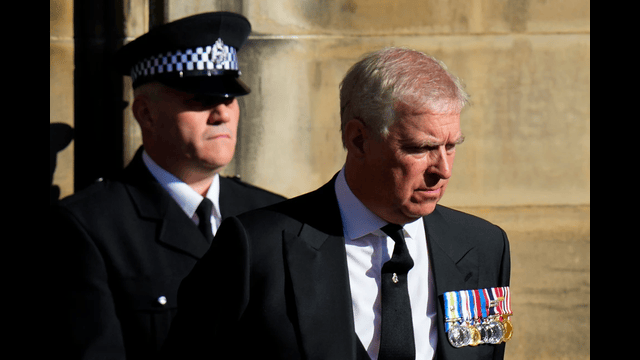
Prince Andrew leaves St. Giles Cathedral after the arrival of the coffin containing the remains of his mother Queen Elizabeth, in Edinburgh, Scotland, Sept. 12,
Britain’s royal family faced intense scrutiny this week after the arrest of King Charles III’s brother.
Police searched royal residences while media outlets debated the widening scandal.
Yet, instead of retreating, the monarchy chose public visibility and routine engagements.
The decision signaled stability during what observers call the gravest royal family crisis in decades.
Royals Maintain Public Schedule During Royal Family Crisis
Despite the turmoil, senior royals continued their official appearances without visible hesitation.
King Charles attended the opening day of London Fashion Week from the front row.
Queen Camilla appeared at a daytime concert, maintaining her planned cultural schedule.
Princess Anne visited a prison, reinforcing the monarchy’s commitment to public duties.
This coordinated normality was not accidental or symbolic alone.
It formed the first strategic response to the expanding royal family crisis.
Officials believe public service helps preserve confidence in the institution.
King Charles Promises Duty and Stability
Following news about his brother’s detention, the king released a brief public statement.
He confirmed the family would cooperate fully with police inquiries.
Charles emphasized that royal duties and national service would continue uninterrupted.
The message aimed to reassure citizens and international observers simultaneously.
Royal historians say such statements are rare and reveal serious institutional concern.
The public signature “Charles R.” underscored his authority and personal accountability.
Arrest Creates Historic Pressure on the Monarchy
The detained royal, Andrew Mountbatten-Windsor, spent eleven hours in custody before release under investigation.
Authorities neither charged nor cleared him, leaving uncertainty hanging over the case.
The arrest concerns alleged misconduct linked to his former public trade role.
Commentators quickly searched history for comparable royal crises.
Some analysts referenced the execution of King Charles I during the seventeenth-century civil war.
Others compared the turmoil to the 1936 abdication of King Edward VIII.
That abdication deeply weakened public faith in the monarchy for many years.
Confidence recovered only during World War II under King George VI’s leadership.
His refusal to abandon Britain strengthened the crown’s moral authority.
Epstein Files Intensify Royal Family Crisis
The current investigation stems from documents released by the U.S. Justice Department.
The files relate to convicted offender Jeffrey Epstein and his international connections.
Reports suggest Andrew shared trade-related information with Epstein in 2010.
Multiple British police forces are now reviewing issues raised within those documents.
Legal experts warn the process could extend for months or even years.
This prolonged uncertainty complicates the monarchy’s efforts to stabilize public opinion.
Royal historian Ed Owens notes the institution lacks a clear historical playbook.
Previous scandals often had direct solutions or leadership changes.
This situation, however, offers no immediate or obvious resolution.
Lessons From Diana’s Death Still Shape Strategy
The royal household remembers the backlash following Princess Diana’s death.
Public anger then focused on the monarchy’s slow emotional response.
Crowds gathered outside Kensington Palace demanding visible compassion.
That experience forced the institution to rethink public communication strategies.
Focus groups later helped the palace understand emotional public expectations.
The changes encouraged future royals to appear more approachable and transparent.
Princes William and Harry later embraced that more informal public style.
However, analysts say today’s media environment is far harsher and faster.
Modern audiences demand immediate answers and complete institutional transparency.
Palace Moves to Separate Andrew From Institution
To protect the crown, the palace removed Andrew’s royal titles and privileges.
He also lost the right to use the title of prince publicly.
Officials hope this clear separation limits damage to the broader monarchy.
The British government is also reviewing his place in the succession order.
Removing him formally would require new legislation from Parliament.
Until then, he technically remains eighth in line to the throne.
Future Questions Could Shape the Monarchy
Experts say the royal family crisis may soon widen beyond one individual.
Investigators could examine what officials or relatives previously knew.
Such inquiries might create uncomfortable institutional questions.
Former BBC royal correspondent Peter Hunt warns the investigation’s scope matters greatly.
If police focus only on Epstein documents, the damage may stay limited.
A broader probe into institutional awareness could prove far more damaging.
For now, the monarchy continues its public routine with deliberate calm.
Whether that strategy restores trust will depend on the investigation’s final outcome.