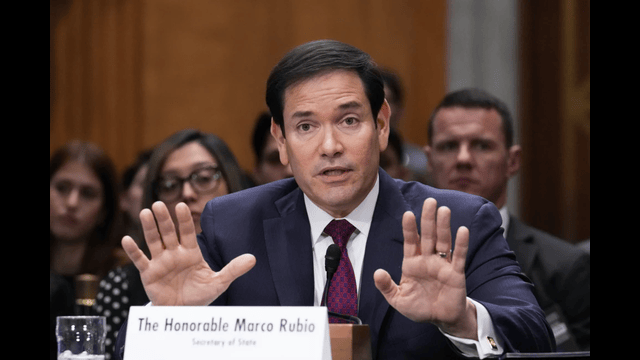
Secretary of State Marco Rubio appears before the Senate Foreign Relations Committee to explain President Donald Trump’s policy toward Venezuela following the U.S. military raid that ousted then-President Nicolas Maduro, at the Capitol in Washington, Wednesday, Jan. 28, 2026.
Secretary of State Marco Rubio strongly defended President Donald Trump’s Venezuela policy during a tense Senate hearing Wednesday.
He also sought to calm allied fears over Greenland, NATO, Iran, and China.
Lawmakers heard the administration’s first detailed public explanation since the January 3 operation in Caracas.
Rubio told the Senate Foreign Relations Committee the action against Nicolás Maduro removed a major regional security threat.
He said the United States is safer today than it was weeks ago.
The secretary argued that Washington now has leverage to stabilize Venezuela.
“We are better off today,” Rubio said, adding that progress would continue over coming months.
He stressed the transition would not be instant.
Still, he expressed confidence in the current interim leadership.
Rubio Defends Trump on Venezuela Operation
Rubio said the raid targeted U.S. security risks in the Western Hemisphere.
He rejected claims that the move would destabilize global politics.
Republican senators largely praised the mission’s speed and precision.
The secretary clarified that Washington does not plan further military action.
He said force would be considered only if an imminent threat emerged.
Such a scenario, he added, is not expected.
Prepared remarks hinted at tougher options.
However, Rubio softened that stance under questioning.
He emphasized diplomacy over continued force.
Oil Sanctions and Economic Controls
Rubio announced that Venezuela may soon resume limited oil sales.
Current sanctions would ease under strict financial oversight.
Revenue would fund basic services like policing and healthcare.
Oil proceeds would enter a U.S. Treasury-controlled account.
Funds would be released after Washington approves monthly budgets.
Rubio said this ensures transparency and accountability.
He argued that controlled oil income could stabilize daily life.
Critics warned it risks entrenching new power structures.
Rubio insisted oversight would prevent abuse.
Democrats Push Back on Global Risks
Democratic senators expressed deep skepticism during the hearing.
They questioned whether Trump’s actions embolden Russia or China.
Concerns also focused on Taiwan and Ukraine.
Rubio dismissed those fears.
He said China’s Taiwan ambitions predate current events.
According to Rubio, Beijing’s plans are “legacy-driven.”
He also rejected claims that Venezuela set a dangerous precedent.
Each global conflict, he argued, stands on its own dynamics.
Greenland and NATO Tensions Addressed
Rubio acknowledged allied unease over Trump’s Greenland rhetoric.
He said tensions inside NATO are easing.
Discussions are underway to manage U.S. security concerns.
Trump argues Greenland is strategically vital.
He cites threats from Russia and China.
Recently, he stepped back from tariff threats against European allies.
Rubio said constructive outcomes remain possible.
He also repeated calls for NATO members to raise defense spending.
According to him, Trump voices long-standing U.S. frustrations more bluntly.
Iran and Middle East Posture
Rubio said the administration has no plan to strike Iran.
Recent military deployments are defensive, he explained.
An aircraft carrier arrived to deter potential Iranian threats.
He warned that regime change in Iran would be complex.
Such a move, he said, requires careful deliberation.
Iran, he noted, differs greatly from Venezuela.
New Details From the Caracas Raid
Committee Chair Jim Risch revealed fresh operational details.
He said about 200 troops were involved.
The firefight lasted under 27 minutes.
Risch called the mission brief and successful.
He said Venezuela may need international election oversight.
Free and fair polls, he argued, remain essential.
Calls for Democratic Elections in Venezuela
Rubio emphasized support for democratic elections.
He said legitimate leadership is the administration’s end goal.
The statement marked his strongest pro-democracy stance yet.
Opposition leader María Corina Machado echoed that message.
She vowed to return soon to aid the transition.
Her comments followed a meeting with Rubio.
Democrats questioned cooperation with interim leaders tied to Maduro.
Delcy Rodríguez now serves as acting president.
Washington has set conditions for future engagement.
Diplomatic Ties Slowly Rebuild
The State Department plans to send staff to Caracas.
The move could reopen the U.S. Embassy closed since 2019.
Full normalization, however, remains distant.
Restoring ties would require a policy reversal.
The U.S. still recognizes Venezuela’s 2015 parliament.
That decision stands for now.