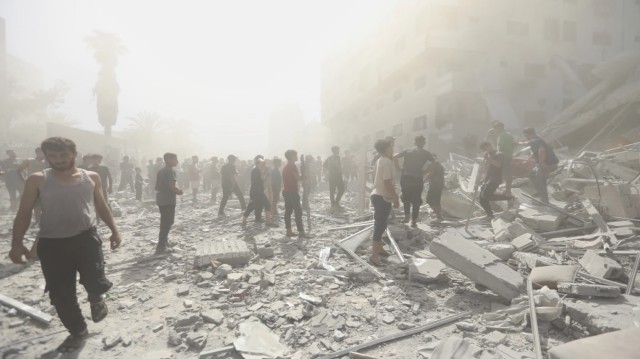
Palestinians inspect the rubble of a building after an Israeli military strike in Gaza City, Sunday, Sept. 14, 2025.
U.S. Secretary of State Marco Rubio arrived in Israel on Sunday as deadly airstrikes intensified across northern Gaza. His visit comes just days after Israel’s controversial attack in Qatar, which killed Hamas leaders and derailed mediation efforts.
Rubio said ahead of the trip that he aimed to hear directly from Israeli officials about their path forward in Gaza. The timing reflects Washington’s attempt to balance ties with key Middle East allies amid rising global pressure.
A Visit Amid Rising Tensions
The two-day trip also serves as a strong display of U.S. support for Israel. Prime Minister Benjamin Netanyahu described the visit as proof of the “durability and strength” of U.S.-Israel relations, likening it to the stones of the Western Wall.
On Sunday, Rubio, Netanyahu, their spouses, and U.S. Ambassador Mike Huckabee visited the historic Western Wall and nearby tunnels.
Yet Rubio’s arrival came against the backdrop of sharp U.S. displeasure. President Donald Trump had expressed anger that Washington was not informed in advance about Israel’s strike in Doha. That attack not only killed six people but also severely damaged efforts for a Gaza ceasefire and hostage release deal.
Qatar Fallout Widens
Before traveling to Israel, Rubio and Trump met Qatar’s prime minister to discuss the fallout. Qatar denounced the Israeli strike, calling it an assault on the principle of mediation.
Sheikh Mohammed bin Abdulrahman Al Thani, Qatar’s foreign minister, said his country remains committed to working with Egypt and the U.S. to reach a truce. However, he warned that Israel’s actions undermined trust in diplomacy.
Arab and Muslim foreign ministers also convened on Sunday to consider a collective response, reflecting the growing frustration in the region.
Gaza Strikes Leave Families Devastated
Meanwhile, Israel’s offensive in Gaza showed no sign of easing. At least 13 Palestinians were killed on Sunday, with dozens more wounded.
One strike in Deir al-Balah killed six members of the same family, including three children. They had fled from Beit Hanoun only days earlier.
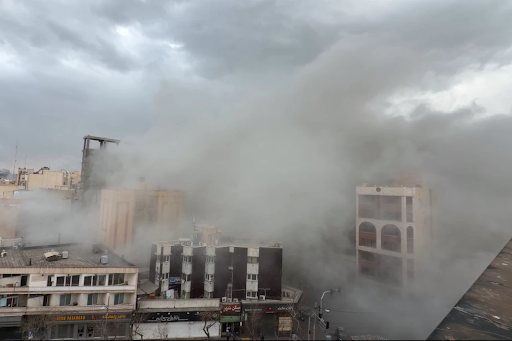
Associated Press footage captured thousands fleeing Gaza City along the seaside road, carrying belongings in cars and carts. Thick smoke from airstrikes trailed in the background as people moved south under constant fear.
Residents said life had become unbearable. “We have begun to wish for death rather than this life,” said Ashraf Elwan, a displaced young man.
High-Rise Buildings Reduced to Rubble
The Israeli military destroyed three high-rise structures on Sunday, including a building within Gaza City’s Islamic University. Residents rushed to save belongings before the demolitions.
Military officials claimed Hamas used these sites as observation posts to monitor Israeli movements. No evidence was provided to support the assertion.
Local hospitals reported casualties but could not confirm the total as bodies remained trapped under debris.
Gaza residents likened the destruction to a repeat of the 1948 Nakba, when Palestinians were displaced during Israel’s creation. Israel has firmly rejected accusations of carrying out genocide in Gaza.
Starvation Crisis Deepens
Beyond the bombings, hunger is claiming lives. Gaza’s Health Ministry confirmed two more Palestinian adults died from malnutrition in the past 24 hours. Since late June, 277 adults and 145 children have died of starvation-related causes.
Israel said over 1,200 aid trucks entered Gaza last week, but humanitarian groups argue supplies fall far short of needs. Looting further prevents aid from reaching desperate families.
Water shortages also remain severe. Repairs on a pipeline from Israel have slightly increased supply, but families still scramble for clean water every few days.
The Broader War
The conflict began when Hamas-led militants launched a surprise assault on Israel on October 7, 2023. Around 1,200 Israelis, mostly civilians, were killed and 251 abducted. Forty-eight hostages remain in Gaza, with Israel believing that 20 are still alive.
Israel’s retaliation has since killed at least 64,871 Palestinians, according to Gaza’s Health Ministry. The figures do not specify how many were civilians or fighters.
Rubio’s visit, against this backdrop of destruction, underscores Washington’s dilemma: standing firmly with Israel while grappling with international criticism and fractured diplomacy.