

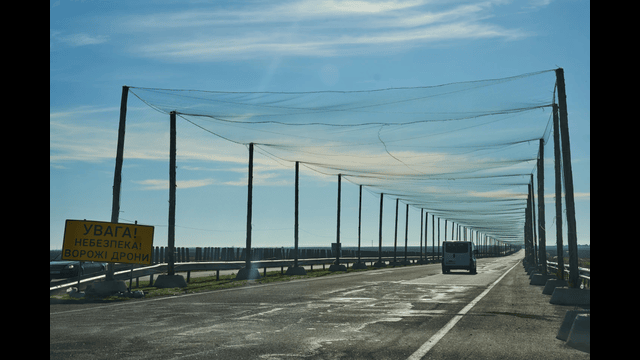
A car drives on the road covered with anti-VFP nets.
Russia’s drone campaign in southern Ukraine has pushed many residents of Kherson back into a life of fear, even two years after the city was liberated. Despite global talks about the Ukraine peace plan, civilians say the situation on the ground is deteriorating, with daily drone strikes turning the region into what many describe as a “human hunting zone.”
Life Under Russia’s Drone Shadow
When Olena Horlova drives through her village near Kherson, she fears every rooftop and roadside. She worries that Russian FPV drones — equipped with live-stream cameras — could be watching her.
Her daughters stay indoors. She returns home along dark roads, sometimes without headlights, trying to avoid detection.
Even after Ukrainian forces liberated the city in 2022, the danger never left. Instead, it evolved.
Drone Attacks Spread Across Southern Ukraine
Kherson was among the first regions targeted by Russia’s short-range FPV drones. What began as isolated strikes has expanded more than 300 kilometers across the right bank of the Dnipro River.
The United Nations Commission of Inquiry on Ukraine said these attacks are deliberate. In its October report, it found evidence of repeated civilian casualties, destroyed homes and forced displacement — enough to classify the drone campaign as crimes against humanity.
For residents like Horlova, the intent feels unmistakable.
She believes civilians are targeted as revenge for the celebrations that erupted when the city was freed from occupation.
“Human Safari”: A New Phase of the War
Four kilometers from the Dnipro River, Horlova’s village of Komyshany has become a frontline testing ground. Locals call it a “human safari,” where drones hover, wait and strike.
FPV drones often land on rooftops when their batteries run low. Then they wait.
“When a person or car appears, the drone lifts off and drops explosives,” Horlova said. “Even animals aren’t spared.”
Russian Telegram channels frequently share strike videos, often with mocking captions. The U.N. report identified specific Russian drone units operating from the occupied left bank of the river.
Investigators attempted to examine Russian claims that Ukrainian forces also target civilians, but they lacked access to occupied areas and received no cooperation from Moscow.
Thousands of Drones, Daily
Exclusive drone interceptions obtained by the Associated Press reveal Russian FPVs scanning for civilian vehicles, including ambulances.
The commander of Ukraine’s 310th Marine Electronic Warfare Battalion, Dmytro Liashok, says at least 300 drones fly toward Kherson daily. October alone saw 9,000 drones over the city.
“This entire area is a training ground,” Liashok said, noting that Russian crews gain real-time combat experience here.
His battalion intercepts over 90% of incoming drones. Yet the remaining few wreak devastation.
Since July 2024, more than 200 civilians in southern Ukraine have been killed and over 2,000 injured, according to local authorities. Nearly 3,000 homes have been damaged.
Hospitals Overwhelmed by Drone Casualties
At Kherson’s main trauma hospital, doctors treat drone victims daily.
Among them is 70-year-old Nataliia Naumova, injured by a Shahed drone while waiting overnight at a school used as a temporary shelter.
She recalls the fear plainly: “People there survive, not live.”
Deputy medical chief Dr. Yevhen Haran describes the injuries as brutal — from amputations to fatal blast wounds.
“It’s simply hunting for people,” he said.
Haran himself survived an FPV drone attack in August. A drone struck the car in front of him, and shrapnel injured multiple passengers.
He later suffered a concussion and still struggles with occasional speech loss.
The Search for Peace Amid Escalating Tensions
As global pressure mounts for a Ukraine peace plan, Russian President Vladimir Putin called the U.S. proposal “a starting point” but demanded Ukraine withdraw from contested regions or face force. Analysts say Moscow is using negotiations to stall while gaining territory.
Ukraine faces its own challenges — from corruption concerns to economic strain — even after securing $8.1 billion in IMF funding.
Yet in Kherson, residents say politics and diplomacy feel distant.
“We survived the occupation,” Dr. Haran said. “We will survive this until peace comes as well.”













