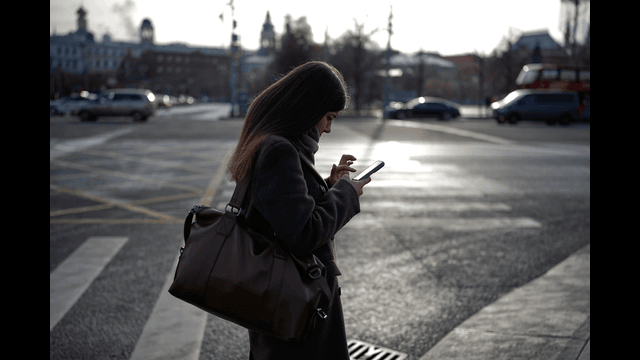
A woman looks at her smartphone in Moscow, Russia, Thursday, Nov 20, 2025.
Russia is facing rising anger over cellphone internet outages that have disrupted everyday life across dozens of regions. What began as temporary anti-drone measures has turned into widespread digital disorder in 2025, affecting communication, payments, transport, and even medical safety.
Digital Blackouts Spread Across Regions
Cellphone internet shutdowns began in May and continued through summer and fall. By November, an average of 57 regions experienced daily disruptions, according to monitoring group Na Svyazi.
Officials argue the outages prevent Ukrainian drones from using mobile networks for navigation. Kremlin spokesman Dmitry Peskov called them “necessary.”
But experts disagree. Analyst Kateryna Stepanenko said the shutdowns have done little to stop drone strikes, pointing to continued attacks on Russian oil facilities.
Life Under a Cellphone Internet Outage
The cellphone internet crisis has changed how Russians manage basic tasks. With mobile data blocked, credit cards fail on public transport. ATMs stop connecting to networks. Messaging apps freeze. Travelers returning from abroad find their SIM cards unusable.
Parents of diabetic children face terrifying gaps in medical monitoring. Their glucose-tracking apps depend on mobile internet. Without it, they can’t track sudden blood sugar drops while children are at school.
Marina, a resident of Vladivostok, said her panic began when only one government banking app worked during an outage. She described a feeling of “losing information and losing freedom.”
Limited Access Through “White Lists”
During outages, only certain government-approved websites remain accessible. These “white lists” vary by provider and include official portals, Yandex services, and limited email platforms.
Some users can access banking apps, while others cannot. Authorities have promised to expand the lists, but many worry this system could evolve into a long-term control mechanism.
New Rules Target SIM Cards
A new anti-drone regulation restricts SIM cards used abroad or inactive for 72 hours. Such cards enter a 24-hour cooling period, blocking data and text messages.
Unblocking requires receiving a text — impossible for SIM cards installed in cars, boilers, electric meters, or Wi-Fi routers. Lawmaker Andrei Svintsov warned that essential devices might simply fail. “This is a massive problem,” he said.
Messaging Apps Hit Hard
Russia has also restricted WhatsApp and Telegram, which had 96 million and 91 million monthly users respectively. Calls on the apps have been throttled since August. In some areas, Telegram has disappeared entirely.
Neither app appears on the restricted “white list.”
Instead, the government pushes MAX, a Russian messaging service criticized over surveillance concerns. MAX shares user data with authorities upon request and lacks end-to-end encryption.
Since September, all smartphones in Russia must come with MAX preinstalled. But adoption remains low. Many users refuse to install it, including Marina, whose employer now insists on it.
Public Adaptation and Resistance
Pollster Denis Volkov says most Russians see the internet restrictions as inevitable, like bad weather. Many give up trying to access blocked content. Others rely on VPNs — though these too are frequently banned.
A resident of Ulyanovsk said he installs a new VPN every few months. His friends exchange recommendations, but he believes most people won’t bother.
Impact on Economy and Daily Operations
Despite tightening controls, experts say Russia cannot fully disable the internet. Mikhail Klimarev of the Internet Protection Society notes that logistics, navigation, supply chains, and retail operations all rely on stable connectivity.
He warns, however, that further restrictions are coming. He expects broader bans on websites, VPNs, and messaging platforms. “They seem to have come up with everything already,” he said, “and they’re still coming up with something more.”
A Growing Concern for 2025
The cellphone internet outages in Russia have become more than an inconvenience. They affect transport payments, medical safety, workplace communication, and personal freedom. As shutdowns intensify, citizens fear a future with more digital isolation and deeper government control.