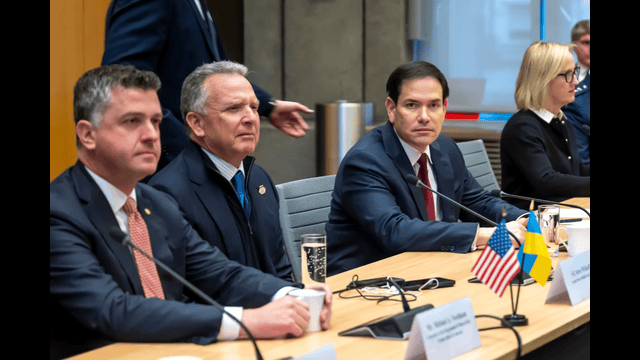
U.S. special envoy Steve Witkoff, second left, and U.S. Secretary of State Marco Rubio, right, sit at the beginning of talks with the Ukrainian delegation at the U.S. Mission to International Organizations in Geneva, Sunday, Nov. 23, 2025.
Top U.S. and Ukrainian officials said on Sunday that meaningful progress had been made in Geneva toward ending the Russia-Ukraine war. Yet the two sides shared very few specifics. Their discussions centered on a controversial American peace proposal that has raised concerns among European allies who fear it may concede too much to Moscow.
A Cautious Sense of Progress in Geneva
U.S. Secretary of State Marco Rubio described the talks as “very worthwhile.” He called it the most productive diplomatic day in years. Rubio added that he felt “very optimistic” about the possibility of a breakthrough.
Despite that optimism, Rubio offered almost no detail about the substance of the negotiations. He also softened the Thursday deadline set by President Donald Trump, saying discussions could easily extend into Monday or beyond. Rubio explained that some issues were still sensitive, noting that several points required higher-level political decisions.
American Peace Plan Sparks Alarm in Europe
The 28-point U.S. proposal aims to bring an end to the nearly four-year Russia-Ukraine war. However, Kyiv and key European capitals have been unsettled by elements of the plan. Ukrainian President Volodymyr Zelenskyy warned that Ukraine might be forced to choose between defending its sovereignty and retaining American support.
The proposal reportedly includes concessions to Russia that Zelenskyy has rejected countless times — including territorial losses. The Ukrainian leader repeated that his people “will always defend their home.”
White House Tries to Ease Kyiv’s Concerns
Late Sunday, the White House attempted to calm rising tensions. It said Ukraine’s delegation confirmed that crucial concerns — sovereignty, long-term security, economic stability, infrastructure protection, and navigation rights — had been addressed.
According to Washington, the updated framework now reflects Ukraine’s “national interests” and includes enforceable security guarantees. The reassurance came after reports that the original Trump-endorsed proposal mirrored a “wish list” from Moscow, not a balanced peace plan.
Allies Push Back on Russia-Friendly Provisions
European leaders have expressed reservations. German Chancellor Friedrich Merz said he stressed to Trump that Kyiv’s sovereignty must remain non-negotiable. France, the U.K., and Germany also reviewed the plan before the Geneva meeting.
France’s Defense Ministry warned that restrictions on Ukraine’s military operations would undermine its sovereignty. “Ukraine must be able to defend itself,” officials emphasized.
Rubio Calls the Document a ‘Work in Progress’
Rubio insisted the peace framework was a “living, breathing document.” He stated that it will continue to evolve — but reminded reporters that Russia must approve any final deal. “The Russians get a vote here,” he said.
Ukraine’s delegation chief, Andrii Yermak, agreed that the talks had moved toward a “just and lasting peace.” His comments stood in contrast to Trump’s recent criticism accusing Ukraine of showing “zero gratitude.”
Zelenskyy responded by praising U.S. support while noting that Russia alone started the war. He stressed that the main goal remained unchanged: ending the Russia-Ukraine war and ensuring it cannot reignite.
Confusion Surrounds Origins of the Proposal
A political uproar emerged after some U.S. lawmakers claimed that Rubio had described the plan as Russian in origin. The State Department denied this. Rubio later suggested that senators had misunderstood him. Still, the conflicting statements triggered confusion in Washington and abroad.
Senator Mark Warner said the plan resembled “Russian talking points,” alarming Europe and causing “ferocious pushback.”
Turkey Steps In With New Diplomatic Effort
Turkish President Recep Tayyip Erdogan announced plans to speak with Russian President Vladimir Putin about reviving the 2022 Black Sea grain deal. The agreement previously allowed Ukraine to export grain safely but collapsed last year.
Erdogan said he would ask Putin to reconsider, calling it a crucial path toward stability. His renewed effort followed a recent meeting with Zelenskyy in Ankara.