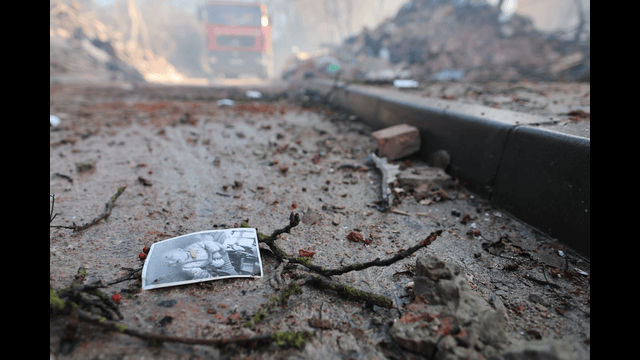
A photograph of a child lies on the ground near a residential building that was heavily damaged by a Russian strike on Ternopil, Ukraine, on Wednesday, Nov. 19, 2025.
A massive Russian drone and missile attack on Ternopil has killed at least 25 people and injured dozens more, intensifying global concern as President Volodymyr Zelenskyy traveled to Turkey seeking stronger diplomatic pressure on Moscow. The overnight strikes devastated residential areas in western Ukraine, far from the active front lines.
Deadly Night Strikes Hit Western Ukraine
The attack struck two nine-story apartment blocks in Ternopil, a city located about 200 kilometers from Poland. Interior Minister Ihor Klymenko confirmed that at least 73 people, including 15 children, were injured.
He also revealed that 19 of the victims were burned alive, including children aged 5, 7, and 16. Rescue teams continue to search the rubble, with two dozen people still missing. Authorities expect operations to continue for at least two more days.
Ukraine’s air force reported that Russia launched 476 strike and decoy drones and 48 missiles across the country overnight. Air defenses intercepted most cruise missiles but said six managed to reach their targets. F-16 and Mirage-2000 jets supplied by Western allies helped intercept at least 10 missiles.
President Zelenskyy condemned the assault, saying each attack on civilians shows that “pressure on Russia is insufficient.”
Zelenskyy’s Diplomatic Push in Turkey
Hours after the deadly strikes, Zelenskyy met Turkish President Recep Tayyip Erdogan in Ankara. The meeting formed part of Zelenskyy’s strategy to isolate Vladimir Putin diplomatically and secure more support in ending the war.
Both leaders stated they remain committed to finding a peaceful resolution, with Turkey positioned as a crucial mediator in the Black Sea region.
“We count on the strength of Turkish diplomacy,” Zelenskyy said, emphasizing Ankara’s unique influence in Moscow.
Zelenskyy hinted at receiving new “signals” from the United States about the war, though he offered no specifics. Washington is preparing new sanctions targeting Russia’s oil sector to pressure Putin back to negotiations.
Earlier, a Turkish official indicated that U.S. envoy Steve Witkoff would join Zelenskyy in Turkey but later corrected the statement. The U.S. Army Secretary, Dan Driscoll, is meanwhile in Ukraine to meet officials, though Kyiv has not confirmed whether peace talks were discussed.
NATO States React as Airspace Threatened
The attack on Ternopil triggered a broader military response. Romania scrambled Eurofighter Typhoon jets and F-16s after a drone entered its airspace during the Russian barrage.
Poland also deployed aircraft and temporarily shut down Rzeszów and Lublin airports to prioritize military operations. Both countries sit on NATO’s eastern flank and have faced repeated spillover risks from the conflict.
Russia’s Defense Ministry said the attack targeted energy facilities, drone depots, and military infrastructure in retaliation for strikes inside Russian territory.
Elsewhere in Ukraine, strikes injured nearly 50 people across multiple regions. In Kharkiv, 46 civilians were hurt, including two young girls. Several residential districts were damaged, along with a school, an ambulance station, and other civilian structures.
Growing Tensions on Both Sides
Russia accused Ukraine of firing four U.S.-supplied ATACMS missiles at the Russian city of Voronezh. The missiles were reportedly intercepted, but debris damaged a private home, an orphanage, and a gerontology center. Russia reported no casualties.
Ukraine’s General Staff confirmed firing ATACMS missiles but did not reveal the target.
A City Shattered, A War Escalating
Ternopil, once considered a relatively calm refuge in western Ukraine, is now mourning one of its deadliest attacks since the war began. Thousands who fled front-line regions had sought safety in the city, only to face new devastation.
As rescuers continue to search through the rubble and NATO allies increase vigilance, President Zelenskyy’s mission becomes even more urgent. The attack has renewed calls for greater international pressure on Russia as Ukraine tries to defend its cities, protect civilians, and push for a path toward peace.