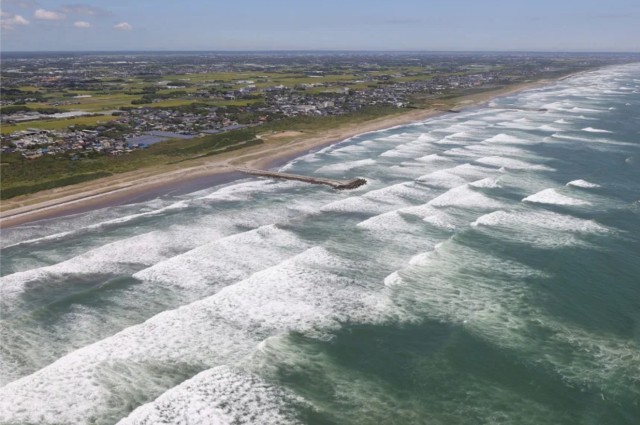
White waves crashed onto the Kujukuri Coast in Japan's Sosa City on July 30.
A powerful tsunami in the Pacific this week didn’t just shake coastlines — it also stirred fears rooted in fiction. As news spread of the tsunami’s rapid advance, many in Asia rushed to their phones. But they weren’t just watching the waves. In China, more than a million people searched for one word: “Prophecy.”
Their concern? A 2021 manga by Japanese artist Ryo Tatsuki. Her comic eerily predicted a major earthquake in July, and for some, this week’s events felt like her forecast had come true.
Manga Prediction Goes Viral in Asia
Tatsuki’s manga, released four years ago, portrays her cartoon self having prophetic dreams. In one frame, she warns of a July quake near the Philippine Sea, followed by massive tsunami waves. The date? July 5, 2025.
Though the actual quake struck days later and far from the predicted site, the manga had already gone viral. Fans across Asia debated its accuracy. Some believed the prophecy was unfolding. Others canceled summer trips to Japan out of fear.
A trending Douyin search — “Ryo Tatsuki’s prediction” — hit over 1.1 million views within hours of the tsunami alert. On social media platform X, one Japanese user posted, “I’m getting goosebumps!” after the news broke.
Tourism in Japan Takes a Hit
The travel industry felt the tremors, too. In Hong Kong, WWPKG travel agency reported a 70% drop in Japan-bound bookings for June and July.
Andrea Wang, a 25-year-old Chinese tourist, canceled her April trip. Even after the tsunami caused minimal damage, she told CNN she wouldn’t risk visiting Japan this year.
Hong Kong traveler Oscar Chu echoed similar fears. Despite visiting Japan often, he stayed home this summer. “I wasn’t sure the prophecy was real,” he said, “but I didn’t want to find out the hard way.”

A notice at a Tokyo train station that part of Japan's high-speed bullet train services were temporarily suspended due to tsunami warnings on July 30.
Prophetic or Pure Coincidence?
Experts urge caution. Seismologists say predicting earthquakes is nearly impossible. The science just isn’t there. Tatsuki herself told Japanese media in May that people shouldn’t be “overly swayed” by her dreams.
Still, the manga’s grip on popular imagination is strong. In Japan, where natural disasters are a part of life, the public often looks for signs and warnings. Memories of the 2011 Tohoku quake — which killed over 22,000 people and caused the Fukushima meltdown — still haunt the nation.
Tatsuki’s earlier work may have fed her mystique. Her 1999 comic The Future I Saw mentioned a “massive disaster in March 2011,” which fans linked to the real-life quake. She has also been credited by believers with foreseeing the deaths of Princess Diana and Freddie Mercury.
Japan Stays Ready for ‘The Big One’
While Tatsuki’s followers debate her powers, Japan is focused on real threats — especially the feared Nankai Trough earthquake. The 700-kilometer-long fault near southern Japan has triggered deadly quakes in the past. Experts warn there’s a 70-80% chance it will strike again within 30 years.
Government agencies remain vigilant. This week’s tsunami response was swift. Over two million people received evacuation alerts. Coastal towns cleared quickly. The damage was limited, but the alertness was real.
Japan’s emergency systems, from earthquake drills in kindergartens to high-speed warnings that halt trains, show how prepared the country is. Last August, a 7.1-magnitude quake triggered a similar rapid response.
A Wake-Up Call for Many
Whether or not Tatsuki’s “prophecy” was accurate, it did spark awareness. On Chinese social app Xiaohongshu, one user wrote, “Thanks to the manga, people paid more attention to disaster risks.”
For a region perched on the Pacific’s volatile Ring of Fire, that awareness might be the real prophecy: stay alert, stay prepared.
And for many travelers? They’ll return to Japan — just not to the beach anytime soon.