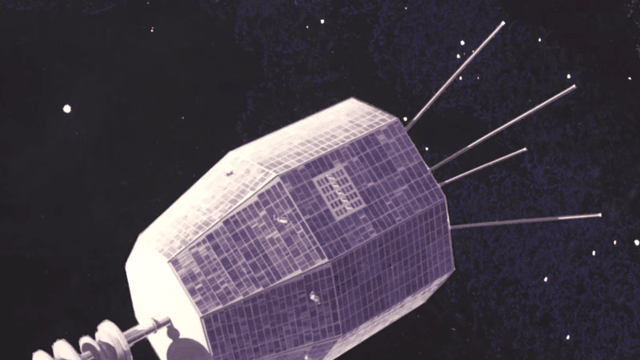
NASA sent the Relay 2 satellite into space in 1964. Its mission ended just three years later. NASA
In June 2024, Australian astronomers detected a strange and very strong radio signal near Earth. At first, they thought it came from a rare, distant cosmic event. Clancy James, a professor at Curtin University, said, “We got all excited, thinking we had discovered an unknown object in the vicinity of the Earth.”
The signal was picked up by ASKAP, a radio telescope made of 36 large dish antennas. The team usually looks for “fast radio bursts” — short but very bright flashes of radio waves from faraway galaxies. These bursts may come from magnetars, which are super dense, highly magnetic dead stars.
Close to Home, Not Space
Soon, the team realized the signal came from only about 4,500 kilometers (2,800 miles) away. That’s very close compared to space objects. The researchers matched it to an old satellite called Relay 2, launched by NASA in 1964.
Relay 2 was a communications satellite, now long dead and considered space junk. It stopped working just three years after launch. It has been orbiting Earth without purpose — until it suddenly sent this strong signal.
What Caused the Signal?
The astronomers studied the signal carefully. They found it lasted only about 30 billionths of a second but was 2,000 to 3,000 times brighter than anything else in the sky.
They suggested two possible causes:
- A sudden electrical spark on the satellite caused by static electricity building up and then releasing, much like a shock you get after walking on carpet.
- A tiny space rock, no bigger than a millimeter, hitting the satellite at very high speed. This could create a burst of hot gas that emits radio waves.
James said the static electricity spark is the more likely cause. These discharges can damage satellites but are harmless to people on Earth.
New Challenges for Astronomers
This event shows how dead satellites can interfere with radio observations of space. James said, “If satellites can produce this as well, then we’re going to have to be really careful.” More satellites are launched every year, which might make it harder to study true cosmic signals without confusion.
Experts not involved in the study agreed with the findings. They said such electrical discharges from satellites are known but rare to detect. Some also said impacts by tiny space rocks could trigger these sparks.
Looking Ahead
The discovery highlights the growing problem of space junk and how it affects scientific research. New telescopes being built in Australia, like the Square Kilometre Array, may help better understand these signals and separate them from real cosmic bursts.