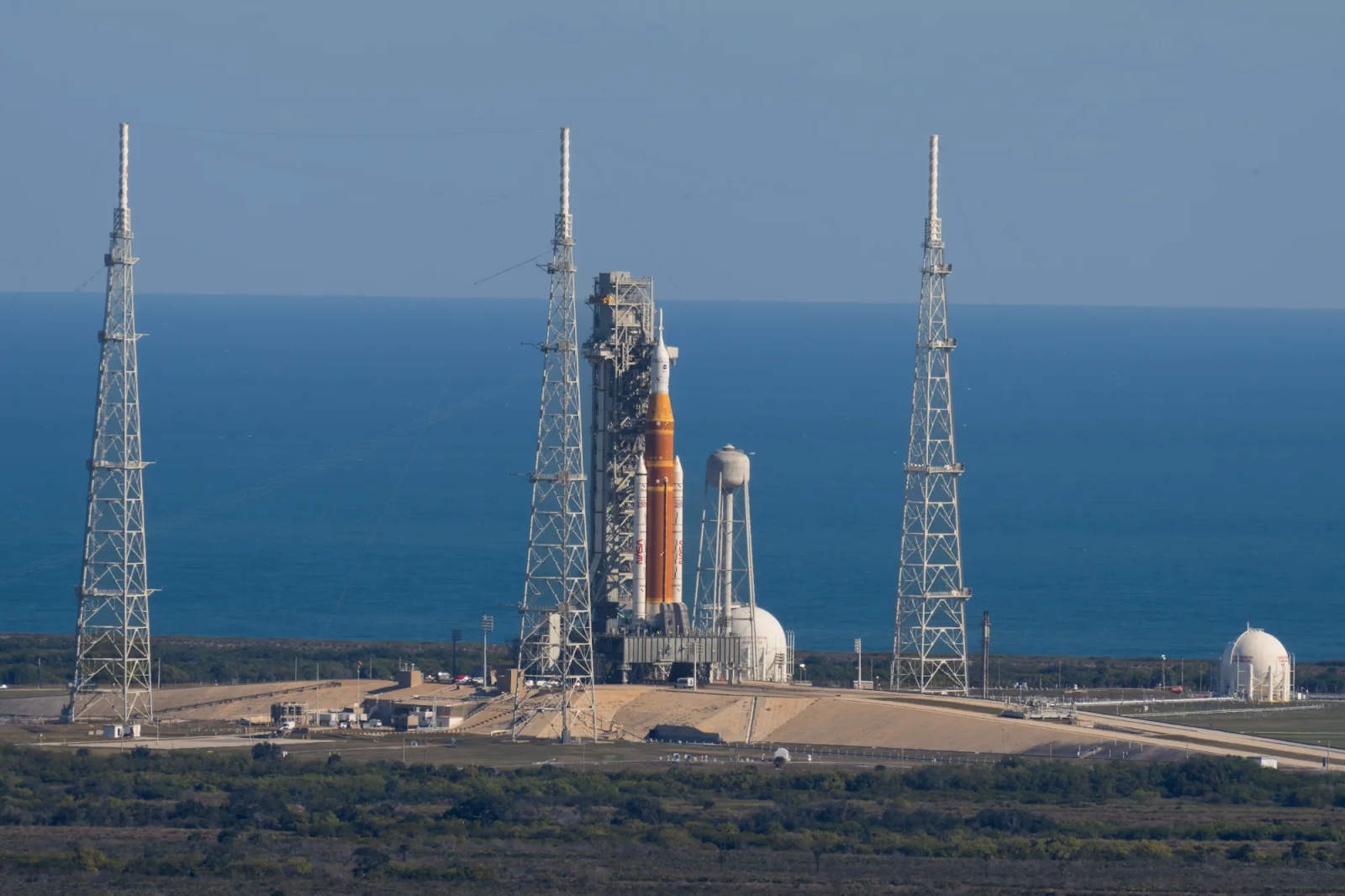
This photo provided by NASA in September 2025 shows NASA’s Carruthers Geocorona Observatory, IMAP (Interstellar Mapping and Acceleration Probe), and the National Oceanic and Atmospheric Administration’s (NOAA) Space Weather Follow On-Lagrange 1 (SWFO-L1) satellite at the Kennedy Space Center in Florida. (NASA via AP)
A trio of space weather satellites blasted off Wednesday morning, aiming to study the sun’s powerful and unpredictable activity. Solar storms can create breathtaking auroras but also disrupt communications and pose risks to astronauts.
The satellites lifted off from Kennedy Space Center shortly after sunrise aboard a single SpaceX rocket. Each satellite will follow its own path toward a sun-orbiting station about 1 million miles (1.6 million kilometers) from Earth.
Together, the missions represent a $1.6 billion investment from NASA, the National Oceanic and Atmospheric Administration (NOAA), and related program costs. NASA’s Joe Westlake called it “the ultimate cosmic carpool,” highlighting the savings achieved by sharing a single launch.
NASA’s IMAP Leads the Mission
Leading the launch is NASA’s Interstellar Mapping and Acceleration Probe (IMAP). It will explore the far reaches of the heliosphere, the protective bubble of solar wind surrounding our solar system.
IMAP will also serve a practical purpose: providing up to a 30-minute warning of solar storms. This early alert will be vital for astronauts traveling to the moon under NASA’s Artemis program, ensuring their safety from solar radiation. Officials anticipate IMAP will be fully operational in time for the next lunar flyby, scheduled for next year.
Carruthers Geocorona Observatory Joins the Fleet
Alongside IMAP, NASA’s smaller Carruthers Geocorona Observatory is on board. The satellite will study Earth’s outermost atmosphere, which glows faintly and stretches far beyond the moon. It honors George Carruthers, the late scientist who created the ultraviolet telescope left on the moon during Apollo 16 in 1972.
NOAA’s Space Weather Sentinel
NOAA’s newest satellite will provide continuous, round-the-clock monitoring of solar activity. It will track solar wind and flares to protect Earth from potentially harmful space weather events. Officials expect NASA’s satellites to be fully operational by early next year, with NOAA’s observatory following in spring.
NASA is funding more than $879 million of the missions, while NOAA’s share totals $693 million.
Advanced Instruments, Sharper Views
While NASA already maintains a fleet of sun-observing spacecraft, these new missions bring more advanced instruments and higher sensitivity. Science mission chief Nicky Fox emphasized that combining data from all three satellites will deliver a far clearer view of the sun than ever before.
“The ability to put all those instruments together gives us a much, much better understanding of the sun,” Fox said.
The missions aim to improve Earth’s protection from solar hazards rather than focusing on auroras. Enhanced forecasting will provide crucial alerts during periods of intense solar activity.
Safety for Artemis Astronauts
NASA officials highlighted the relevance for the Artemis lunar program. If a major solar storm occurs while astronauts are in space, they can seek temporary shelter under the capsule floor to avoid dangerous radiation levels. These satellites will ensure timely warnings, improving safety for crewed lunar missions.
With the launch successfully completed, scientists are eager to begin receiving data. The missions promise to expand humanity’s understanding of the sun, protect technological systems on Earth, and keep astronauts safe as we return to the moon.