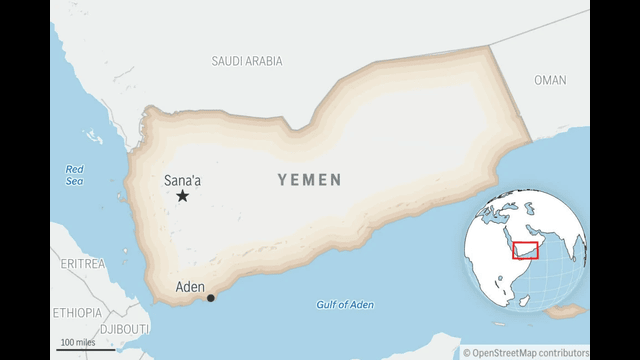
This is a locator map for Yemen with its capital, Sanaa
Saudi Arabia bombs Yemen’s port city of Mukalla, marking a sharp escalation in the country’s long-running conflict.
The strikes targeted what Riyadh described as a weapons shipment meant for separatist forces, allegedly arriving from the UAE.
The incident deepens fractures within the anti-Houthi coalition and raises regional security concerns across the Red Sea.
Airstrikes Signal New Escalation
Saudi Arabia bombs Yemen after accusing separatist forces of receiving military supplies by sea.
The Saudi-led coalition said the weapons posed an immediate threat to stability in eastern Yemen.
The attack highlights growing tensions between Riyadh and the UAE, once close partners in the war.
A military statement released by the Saudi Press Agency confirmed the strikes early Tuesday.
It said vessels arriving from Fujairah had unloaded arms and combat vehicles at Mukalla port.
Saudi officials claimed ship tracking systems were deliberately disabled during the operation.
Claims of Weapons Transfer
According to the Saudi statement, the shipment supported the Southern Transitional Council, or STC.
The STC is a separatist group backed by the UAE and seeks an independent southern Yemen.
Saudi Arabia described the delivery as a dangerous escalation threatening regional peace.
The coalition said it conducted a “limited and precise” overnight airstrike.
Officials insisted the timing reduced risks to civilians and nearby infrastructure.
No immediate casualty figures were released following the attack.
UAE and STC Response Remains Limited
The UAE did not immediately comment on the strikes or Saudi allegations.
The STC-affiliated AIC television channel acknowledged the bombing without offering details.
Silence from Abu Dhabi adds uncertainty to already strained diplomatic ties.
Analysts believe Saudi Arabia bombs Yemen to send a political warning, not just a military signal.
The strike underscores Saudi concerns about separatist advances in strategic eastern regions.
It also reflects Riyadh’s control over Yemeni airspace.
Ships and Surveillance Footage
Analysts identified one targeted vessel as the Greenland, a roll-on roll-off ship.
Tracking data showed it docked in Fujairah on December 22 before reaching Mukalla.
The ship is registered in St. Kitts, with ownership reportedly linked to Dubai.
Saudi state television later aired surveillance footage from the operation.
The video appeared to show armored vehicles moving toward a staging area.
Vehicle types matched images circulating earlier on social media.
Mukalla’s Strategic Importance
Mukalla lies in Yemen’s Hadramout governorate, a region recently seized by STC forces.
The port city sits around 480 kilometers northeast of Aden.
Aden remains the main base for anti-Houthi authorities.
Saudi Arabia bombs Yemen just days after earlier strikes on STC positions.
Those attacks were described by analysts as warnings to halt separatist expansion.
The STC had displaced Saudi-backed National Shield Forces in the area.
Southern Secession Push Grows
Supporters of the STC have increasingly raised the former South Yemen flag.
South Yemen existed as an independent state between 1967 and 1990.
Public rallies now call for renewed secession from the north.
These developments pressure Saudi-UAE relations, despite their shared economic interests.
Both countries remain key OPEC members and regional power brokers.
Yet competition for influence has intensified in recent years.
Wider Red Sea Tensions
The Yemen strike comes amid instability across the Red Sea region.
Saudi Arabia and the UAE back opposing sides in Sudan’s ongoing conflict.
Violence there has further complicated regional alliances.
Meanwhile, Israel recently recognized Somaliland as an independent state.
The move alarmed Yemen’s Houthi rebels, who issued fresh threats.
Houthis warned they would target any Israeli presence in the region.
As Saudi Arabia bombs Yemen once again, regional fault lines appear increasingly fragile.