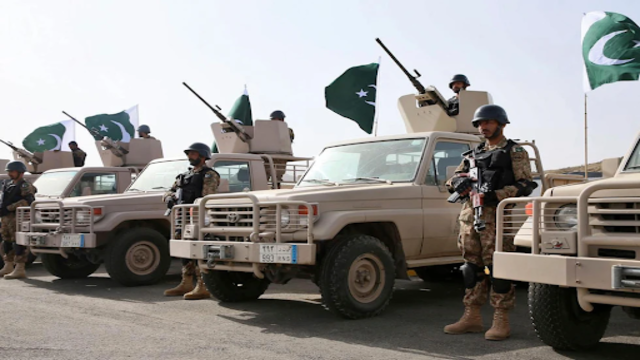
In this Monday, March 30, 2015 file photo provided by the Saudi Press Agency (SPA), Royal Saudi Land Forces and units of Special Forces of the Pakistani army take part in a joint military exercise called “Al-Samsam 5" in Shamrakh field, north of Baha region, southwest Saudi Arabia. Associated Press
Saudi Arabia has signed a landmark mutual defense pact with nuclear-armed Pakistan. The deal comes days after Israel’s strike on Qatar, escalating tensions in the Middle East. The pact declares that any attack on either country will be treated as an attack on both.
The signing was announced on Wednesday by Saudi Crown Prince Mohammed bin Salman and Pakistan’s Prime Minister Shehbaz Sharif. Statements from both governments confirmed that the agreement strengthens defense cooperation and joint deterrence against external aggression.
A Strong Message Amid Regional Tensions
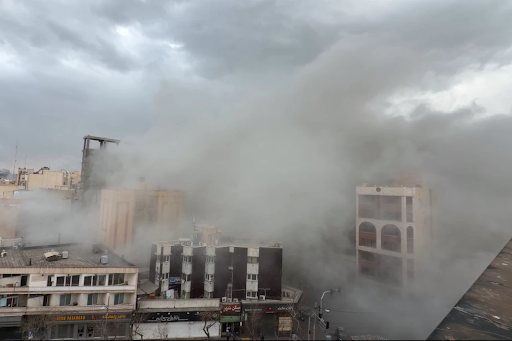
The timing of the pact appears intentional. Israel, widely believed to be the only nuclear-armed state in the Middle East, has expanded its military operations after Hamas’ October 7, 2023, attack. Its strikes have extended into Iran, Lebanon, Syria, Yemen, Palestinian territories, and most recently, Qatar.
By aligning with Pakistan, Saudi Arabia signals a direct warning to Israel. Analysts suggest the agreement is the kingdom’s strongest defense commitment since the Qatar strike. Israel has not yet responded to the development.
Decades of Defense Cooperation
The Saudi-Pakistani defense relationship is not new. It dates back to the late 1960s when Pakistani troops were first deployed to protect Saudi Arabia amid concerns over Egypt’s role in Yemen’s conflict.
These ties deepened after Iran’s 1979 Islamic Revolution, which fueled Riyadh’s fear of Tehran’s growing influence. Since then, Pakistani forces have consistently pledged to defend the holy cities of Mecca and Medina whenever needed.
Pakistan’s Nuclear Program and Saudi Arabia’s Interest
Pakistan built its nuclear arsenal to counter India. Yet, Saudi Arabia has long shown interest in Islamabad’s program. Reports suggest the kingdom provided financial support during the weapons’ development phase.
Retired Brig. Gen. Feroz Hassan Khan, in his book Eating Grass: The Making of the Pakistani Bomb, noted that Saudi Arabia’s funding played a significant role in Pakistan’s nuclear journey.
Declassified U.S. diplomatic cables released by WikiLeaks in 2007 revealed that Saudi officials viewed Pakistan as a natural partner in nuclear security. According to those cables, Riyadh considered itself the logical “protector” of the region, given the financial constraints of other Arab states like Egypt.
The Civilian Nuclear Angle
While the defense pact avoids directly mentioning nuclear weapons, Saudi Arabia has explored nuclear energy programs. The kingdom has previously sought U.S. support for civilian nuclear power. That proposal was linked to a potential normalization deal with Israel before the 2023 Hamas attack derailed talks.
However, enrichment of uranium inside Saudi Arabia raises concerns for nonproliferation experts. Spinning centrifuges could pave the way toward a weapons program. Crown Prince Mohammed bin Salman has publicly stated that if Iran develops a nuclear weapon, Riyadh would follow suit.
Diplomatic Balancing with Iran
The defense pact also comes against the backdrop of Saudi-Iran diplomacy. Iran recently sent Ali Larijani, secretary of its Supreme National Security Council, to Riyadh. This visit hinted at ongoing efforts to sustain the Chinese-mediated détente reached in 2023 between the two rivals.
By signing the agreement with Pakistan, Saudi Arabia signals both deterrence and balance — strengthening ties with a trusted ally while still engaging diplomatically with Tehran.
A Turning Point in the Gulf
The Saudi-Pakistan defense pact may reshape security dynamics in the Gulf. It places Pakistan’s nuclear-armed military partnership at the heart of Saudi strategy.
For Israel, already facing regional pushback after its strikes, the message is clear: Riyadh is ready to act. For Iran, the move complicates its calculations, even as dialogue continues. And for global powers, it raises pressing questions about nuclear proliferation and Middle Eastern stability.
As tensions rise, the pact underscores one reality: Saudi Arabia is no longer relying solely on Western security guarantees. Instead, it is forging its own path with Pakistan by its side.