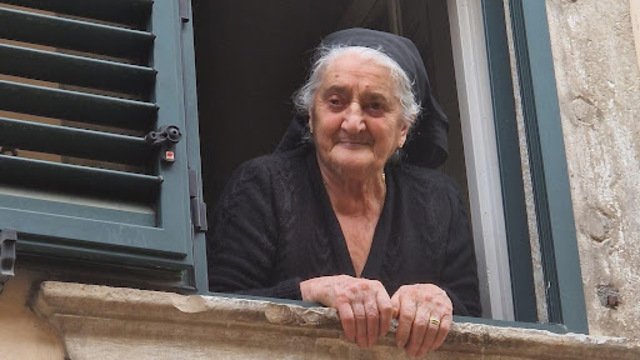
Margherita Ciarletta’s traditional outfit is drawing tourists’ attention. Getty Images
In the medieval mountain village of Scanno, central Italy, 94-year-old Margherita Ciarletta continues a tradition few can remember. She wears the centuries-old local costume every single day, making her the last resident to do so. Tourists visit the cobbled streets not only for the views and churches but to meet “Nonna Margherita,” also called “L’Ultima Regina,” or the Last Queen.
Despite the attention, Ciarletta insists she’s just an ordinary grandmother proud of her roots. “I’ve always liked this dress, I am proud to wear it,” she says.
The Costume and Its History
Ciarletta’s daily attire is a dark wool gown with long sleeves and a cotton headband. It represents one of two traditional wardrobes worn by Scanno’s women for centuries. The second, more elaborate version was for church and festivals, decorated with embroidery to show social status. Some local women still wear the ornate version during events, but only Ciarletta maintains the everyday dress at all times. She rotates between black and dark blue gowns each week.
“That was, and still is, my ordinary everyday dress,” she explains. Her husband never liked it, but she wore it anyway, both for fieldwork and celebrations.
Life in Scanno
Born and raised in Scanno, Ciarletta has lived in the same stone house since 1950. She manages daily chores alone, occasionally using a walking stick. “I do everything on my own,” she says. “I clean the garden, cook, walk, and spend time with friends, neighbours, and family.” She now avoids her morning espresso trips to the local bar, but enjoys cooking for her grandchildren, making handmade pasta and gnocchi with turnip greens.
Her family helps protect her privacy and keeps tourists respectful. While she allows photos for Instagram, she has turned away television crews and once shooed away unwelcome visitors.
From Local to Attraction
After the deaths of her two sisters, who also dressed traditionally, Ciarletta became Scanno’s last woman in the costume. Word spread through social media and travel guides, and visitors now seek her out for photos. Local officials hope UNESCO will recognize Scanno’s costume as intangible cultural heritage.
Despite her fame, Ciarletta is clear that tourism isn’t her priority. She enjoys modern conveniences and the slower pace of life. “I have worked all my life in the fields until I was 70. That was tough work. Today I relax, I enjoy being a grandmother, I’m happy with my life,” she says.
Memories of a Vanishing World
Ciarletta recalls a time when Scanno thrived. The village had over 4,000 residents in the 1920s; now only 1,600 remain. Families moved away, seeking better opportunities abroad. She misses the old sense of community and the lively neighborhood gatherings. “I miss some lost traditions. Today I am sometimes alone,” she says. Yet, she embraces the comforts of modern life without regret.
Though she has left Scanno only a few times and never travelled abroad, she remains a symbol of living history, connecting visitors with a past long gone.