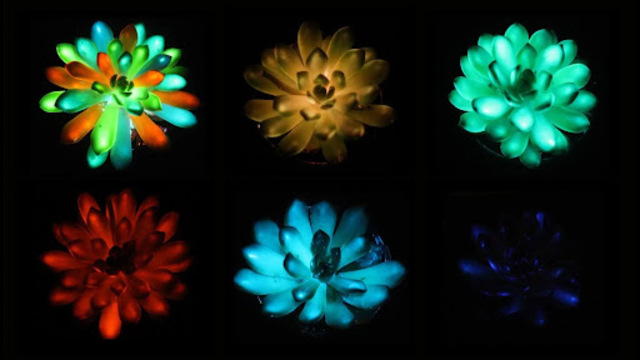
A team of researchers in China has developed a new way to make plants glow by injecting them with nanoparticles.
Glowing plants once sounded like a dream from a science fiction movie. Today, that dream looks closer to reality. Scientists in China have created the world’s brightest and first multicoloured glow-in-the-dark plants.
These plants shine bright enough to light up nearby objects for hours. The team hopes this could one day lead to glowing trees replacing streetlights.
How Scientists Made Them Glow
Biologist Shuting Liu and her team at South China Agricultural University developed this breakthrough. Instead of editing plant genes, they injected succulents with strontium aluminate. This material is the same used in glow-in-the-dark toys. It soaks up sunlight and slowly releases it as light.
The result is stunning. The plants glow in red, blue, and green. Earlier methods could only produce a faint green glow.
“Picture the world of Avatar, where glowing plants light up an entire ecosystem,” Liu said in a statement. She added, “Imagine glowing trees replacing streetlights.”
Testing the Brightness
The team tested the plants by building a wall of 56 glowing succulents. The wall gave off enough light to read text and see objects from four inches away.
After just a few minutes in the sun, the plants glowed for up to two hours. They could be “recharged” repeatedly by placing them back under sunlight. Even 25 days after treatment, the plants continued to glow under UV light.
Older leaves still glowed faintly even after wilting. To protect the plant tissues, researchers coated the glowing material with a special chemical barrier.
Future Possibilities and Concerns
The scientists believe their research shows the potential for sustainable, plant-based lighting. Such plants could collect sunlight during the day and give off light at night.
However, not everyone is convinced. John Carr, a plant science professor at the University of Cambridge, called the work “fun but beyond current technology.” He doubts plants could ever produce enough energy to act as streetlights.
Liu admitted the technology is still in its early stage. The glow is not yet strong enough for real lighting. She also said safety checks are still needed to ensure the glowing materials are safe for both plants and animals.
Despite challenges, the research opens new doors. If improved, glowing plants could reduce energy use and change how cities light their streets.