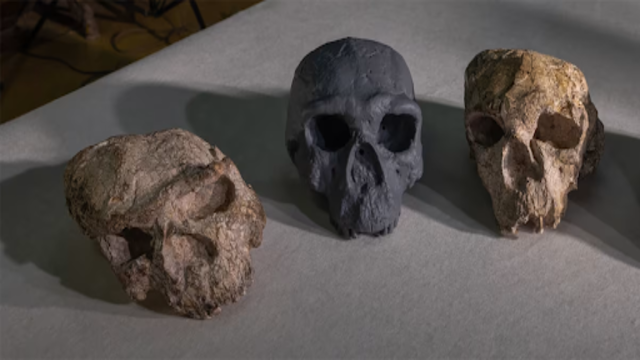
A newly rebuilt image (centre) of the crushed Yunxian 2 skull (right) from China is shown alongside another damaged skull (left) found at the same location. CNN
Scientists studied a crushed skull found decades ago near a river in central China. The skull, thought to be about 1 million years old, puzzled researchers for years because it didn’t fit well with known human fossils. Using modern technology, scientists rebuilt the skull’s shape and discovered it shares features with a mysterious group called Denisovans, and a recently found fossil nicknamed “Dragon Man.”
The study suggests that Denisovans, an ancient group of humans known mostly from DNA, appeared much earlier than scientists believed. This discovery changes what we know about how different human species evolved over time.
What the Study Shows
Researchers published their findings on Thursday in the journal Science. They say the new evidence pushes back the split between human groups like Homo sapiens (us), Neanderthals, and Denisovans by hundreds of thousands of years.
“This changes a lot of thinking because it suggests that by one million years ago, our ancestors had already split into distinct groups,” said Chris Stringer, a lead researcher in human evolution at London’s Natural History Museum.
If confirmed, the findings would mean modern humans and related species began to separate from each other much earlier than previous studies suggested.
Where the Skull Came From
The skull comes from Yunxian, a site in China’s Hubei province. Two skull fragments were found in 1989 and 1990. A third skull was found nearby in 2022 but has yet to be fully studied.
Xiaobo Feng, a professor involved in the research, explained why they focused on this fossil. “A fossil of this age is critical for rebuilding our family tree,” Feng said.
Both skulls had been squashed and damaged over thousands of years underground. The better-preserved one, called Yunxian 2, became the focus. Scientists used CT scans and virtual tools to digitally rebuild the skull and correct its shape.
A New Family Connection
At first, some experts thought the skull belonged to Homo erectus, a well-known early human species. But parts of the skull didn’t match Homo erectus features. Instead, the researchers say Yunxian 2 links to “Dragon Man,” or Homo longi, discovered in 2021. Studies also connect Dragon Man to the Denisovans.
The research suggests other unclear fossils found in China may also belong to this same group, including one nicknamed “Homo juluensis” or “huge-headed man.”
A New Picture of Human Evolution
Using information from Yunxian 2 and over 100 other skull fossils, researchers built a family tree showing how different human species split from each other over the last million years. The new timeline suggests Denisovans and modern humans shared a common ancestor about 1.3 million years ago. Neanderthals split even earlier, about 1.4 million years ago.
This means Denisovans are closer relatives to modern humans than Neanderthals, challenging older ideas about human ancestry.
Expert Opinions
Ryan McRae, a scientist not involved in the study, agreed the skull reconstruction fits the Denisovan group but questioned some parts of the new family tree. He said, “The Homo longi/Denisovan group and Homo sapiens look more similar to each other than they do to Neanderthals.”
The researchers plan to study more fossils, including those from Africa, to better understand the complex story of human origins.
Looking Ahead
This study challenges the old view that modern humans and their closest relatives began evolving only about 500,000 years ago. It also raises questions about where these early human groups lived—inside Africa or elsewhere.
Stringer noted, “East Asia preserves crucial clues to the later stages of human evolution.”
The discoveries remind us that there is still much to learn about our ancient past.