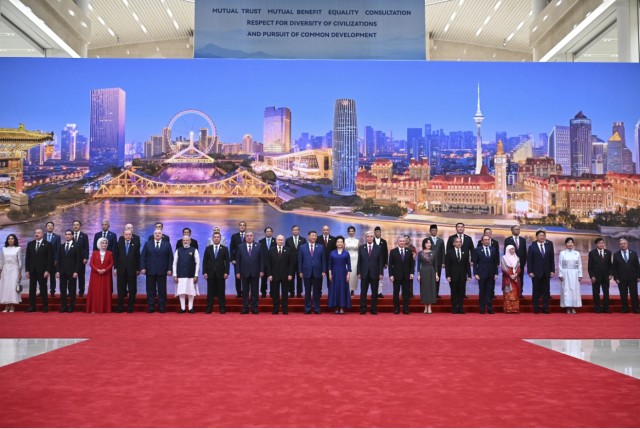
Russian President Vladimir Putin, center left, Chinese President Xi Jinping, center, and his wife Peng Liyuan, center right, pose for a photo with other leaders during a ceremony to welcome Heads of States of the Shanghai Cooperation Organization (SCO) summit in Tianjin, China , on Sunday, Aug. 31, 2025.
Leaders of the Shanghai Cooperation Organization (SCO) are gathering in Tianjin, China. The summit brings together Russian President Vladimir Putin, Indian Prime Minister Narendra Modi, and leaders of eight other nations. The two-day meeting is being viewed as a challenge to the United States’ inconsistent approach to trade and regional conflicts.
Although the SCO has expanded its influence over 24 years, its purpose remains vague. Despite limited recognition globally, it is increasingly seen as a powerful grouping shaping regional politics.
SCO Expands Its Membership and Reach
The SCO now has 10 full members — Russia, China, India, Iran, Belarus, Pakistan, Kazakhstan, Kyrgyzstan, Tajikistan, and Uzbekistan. Initially formed to counter U.S. influence in Central Asia, the group added India and Pakistan in 2017, Iran in 2023, and Belarus in 2024.
Some members, such as Iran and Belarus, are openly hostile to the West. Others, like India and China, maintain a complex relationship with Washington. U.S. tariffs, trade disputes, and its wavering stance on Russia’s war in Ukraine have pushed these nations closer to each other.
From Regional Bloc to Strategic Alliance
Founded in 2001, the SCO has largely been shaped by China’s economic power and Russia’s regional ambitions. While China drives economic cooperation, Russia has used the platform to maintain influence over former Soviet republics in Central Asia.
Russia’s declining economy and Western sanctions have weakened its role. Yet, through the SCO, both Moscow and Beijing continue to push for military cooperation, though this remains limited to joint drills and symbolic exercises.
The inclusion of Belarus, Iran, Pakistan, and India signals the group’s intent to gain global weight. However, the value of their membership varies. Iran and Belarus face international isolation, while Pakistan remains heavily reliant on China for military support.
India’s Balancing Act
India’s entry into the SCO presents a new dynamic. Traditionally neutral, New Delhi has pursued policies aligned with self-interest.
Since the Russia-Ukraine war, India has increased imports of Russian oil, frustrating Washington. Modi has also engaged in cautious diplomacy with Beijing, noting “steady progress” in relations despite border tensions.
Yet India remains wary. It is unlikely to support Russia’s Ukraine war or China’s territorial ambitions in Taiwan and the South China Sea. Its refusal to sign the SCO’s joint statement over the omission of a Kashmir terror attack shows New Delhi’s independent stance.
India’s participation is strategic. It gains a seat at the table while avoiding firm alignment with either China or Russia. Meanwhile, its push for a permanent U.N. Security Council seat continues, though it lacks strong support from Beijing and Moscow.
China’s Low-Risk Investment
China has revealed little about its expectations from the summit. Its state media framed the gathering as the “largest-ever SCO summit” and a platform to design the next decade of development.
By highlighting increased trade and rail connectivity among SCO members, Beijing emphasizes economic benefits over security commitments. For China, the summit offers a low-risk opportunity to showcase leadership while avoiding heavy obligations.
A Platform for Xi Jinping’s Global Vision
Experts view the SCO as central to Xi Jinping’s vision of a multipolar world order. The summit precedes China’s military parade marking the 80th anniversary of World War II’s end, giving Xi global visibility.
The SCO is trying to move from dialogue to practical cooperation. Yet its long-term impact remains uncertain. Critics argue that despite its ambitions, the organization has yet to prove its effectiveness in addressing global challenges.
For Xi, however, hosting the summit bolsters his image as a leader reshaping international order. Whether the SCO can deliver beyond symbolic gestures is still an open question.