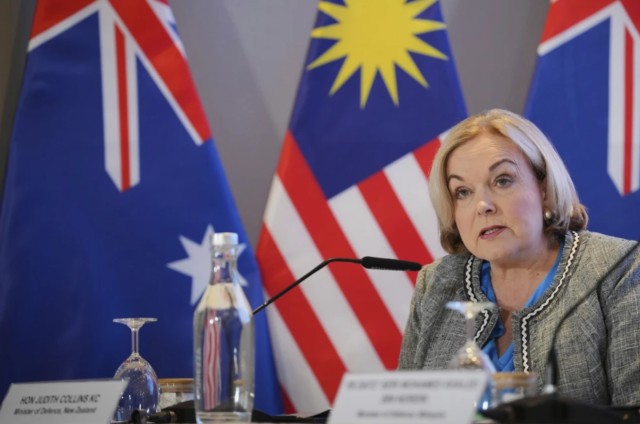
New Zealand’s Defence Minister Judith Collins, speaks during a press conference on the sidelines of the Shangri-la Dialogue for the Five Power Defence Arrangements (FPDA) Defence Ministers’ Meeting [FDMM], in Singapore, Friday, May 31, 2024.
New Zealand has unveiled a major military spending package worth $1.6 billion to modernize its aging fleet of aircraft and helicopters. The government confirmed that a bulk of the funds will go toward buying advanced helicopters from the United States, marking a significant step in strengthening its defense capabilities.
A Shift in New Zealand’s Defense Strategy
For decades, New Zealand’s defense spending has lagged behind its allies in the Five Eyes intelligence-sharing network — the United States, United Kingdom, Canada, and Australia. But increasing global instability has pushed Wellington to rethink its approach.
Foreign Minister Winston Peters called the current environment the “most challenging” in the nation’s modern history. He stressed that New Zealand could no longer rely on distance and isolation as natural defenses.
Key Aircraft and Helicopter Purchases
The newly announced package includes five MH-60R Seahawk helicopters and two Airbus A321XLR planes. These purchases will replace outdated fleets, including the aging Boeing 757s and Kaman Seasprite helicopters, which have struggled with frequent breakdowns.
The Boeing 757s, already secondhand when purchased decades ago, have recently faced embarrassing failures while carrying government leaders abroad. Replacing them is now seen as essential for both reliability and security.
Focus on US-Built Seahawk Helicopters
More than NZ$2 billion of the package is earmarked for the Seahawk helicopters. Defense Minister Judith Collins confirmed that New Zealand would bypass open tenders and procure the aircraft directly through the United States’ foreign military sales program.
However, she acknowledged the acquisition could take several years. “We will need to wait in line,” she said, explaining that new helicopters require a production schedule. Despite the delay, officials view the move as a vital investment in maritime and defense readiness.
Not About Trade Relations, Says Collins
Some questioned whether the U.S. deal was linked to ongoing trade frictions. New Zealand exports currently face a 15% levy under Washington’s global tariff plan. But Collins dismissed suggestions that the purchase was aimed at smoothing trade disputes.
She noted that the Seahawk is already in service with Australia, the U.S., and several other allied nations, making it a practical and proven choice.
Strengthening Ties with Australia
The announcement comes soon after New Zealand and Australia pledged closer military cooperation. Both nations face growing pressure from China’s expanding influence in the South Pacific, an area once overlooked by Western powers but now central to global competition.
By aligning their defense assets, the two neighbors aim to strengthen regional security while ensuring interoperability in military operations.
Balancing Military and Humanitarian Roles
Historically, New Zealand’s defense forces have been more active in humanitarian and disaster relief missions than in combat. This has shaped public perception and often made it difficult to justify large defense budgets.
But leaders now argue that the nation’s security environment has changed. “Defense is not something that can be mothballed until you need it,” Collins said. Her statement underlined the urgency of maintaining a modern, reliable military fleet.
Preparing for Future Challenges
New Zealand’s plan to double defense spending from 1% to 2% of GDP within a decade reflects its growing recognition of strategic risks. The move signals a more proactive stance in preparing for regional threats and global power rivalries.
For a country of just 5 million people, the investment is significant. Yet officials believe it is necessary to protect national interests and contribute to international security efforts.
Conclusion
New Zealand’s decision to buy U.S. Seahawk helicopters and Airbus aircraft highlights a major turning point in its defense policy. The $1.6 billion upgrade is more than just replacing old equipment — it’s a declaration that the country is ready to step up its role in a changing Pacific landscape.