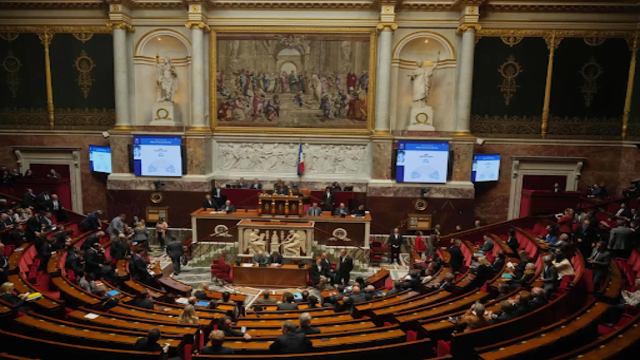
Scoreboards at the National Assembly show the results of a no-confidence motion vote on French Prime Minister Sébastien Lecornu’s government in Paris, Thursday, Oct. 16, 2025. Associated Press
France’s political tensions eased temporarily on Thursday after Prime Minister Sébastien Lecornu survived two consecutive no-confidence motions. The votes spared the government from another collapse and provided President Emmanuel Macron a brief reprieve. However, deeper challenges remain as France approaches critical budget negotiations.
Minority Government Faces Ongoing Struggles
Despite the temporary relief, France’s core political problem persists. The eurozone’s second-largest economy continues to operate under a minority government. The National Assembly is highly fragmented, with no single party or coalition holding a majority.
Every major law now hinges on last-minute agreements, making parliamentary sessions tense and unpredictable. The next major test looms with the national budget, which must be approved before year-end.
Parliament Drama Unfolds
Thursday’s no-confidence votes were dramatic but ultimately unsuccessful. The hard-left France Unbowed party filed the first motion, but it fell 18 votes short of the 289 required to unseat the government. A second motion from the far-right National Rally also failed.
Had Lecornu lost, Macron would have faced difficult choices: call new elections, appoint another prime minister—France’s fifth in under a year—or potentially resign, though he has ruled that out.
How France Reached This Point
The current crisis traces back to Macron’s decision to dissolve the National Assembly in June 2024. That move backfired, producing a chamber dominated by his opponents, yet without a clear majority.
Since then, Macron’s minority governments have negotiated support bill by bill, often collapsing under pressure. This situation clashes with the Fifth Republic’s design, established in 1958 under Charles de Gaulle. The system favors a strong presidency and stable parliamentary majorities—not coalition bargaining in a fractured assembly.
The result: key votes have become cliffhangers, testing public patience and unsettling markets. France, once considered a model of stability in the eurozone, now faces repeated political turbulence.
Pension Law at the Center of Controversy
The pension law, raising the retirement age from 62 to 64, remains highly contentious. Lecornu offered to slow its implementation by roughly two years to gain opposition support. This delay would cost the government an estimated 400 million euros in 2026 and 1.8 billion euros in 2027. Officials insist offsets will cover these expenses.
Pensions remain a sensitive topic in France. The 2023 law sparked nationwide protests and strikes, leaving public spaces littered with debris. The government even invoked Article 49.3, allowing legislation to pass without a parliamentary vote—but this only fueled public outrage.
Budget Negotiations Loom Large
Surviving the no-confidence votes gives Macron’s government a temporary pause before the 2026 budget debate, scheduled for October 24. Lecornu has promised not to use Article 49.3 for the budget, meaning every line requires support in parliament.
Currently, the government and its allies hold fewer than 200 seats. Achieving a majority requires backing from opposition parties, notably the Socialists with 69 lawmakers and the conservative Republicans with 50. While both parties supported Lecornu during the no-confidence votes, their future support is uncertain. The Socialists argue that the current budget proposal lacks “social and fiscal justice.”
Deficit, Taxes, and the Road Ahead
France’s deficit hovers around 5.4% of GDP, with the government aiming to reduce it to 4.7% in 2026 through spending restraint and targeted taxes. The left favors wealth taxes on ultra-rich individuals, while the government prefers smaller, lower-yield measures. Analysts expect hard negotiations over benefit freezes, higher medical deductibles, and local authority savings.
Stakes for Macron
The clock is ticking. Macron’s administration must secure a budget, justify the pension law delay, and negotiate with both left and right factions. Success would demonstrate France’s ability to pass a credible budget and reduce the deficit without resorting to extraordinary measures.
Failure, however, could reopen the crisis, risking another government collapse and leaving France politically deadlocked as the year ends.